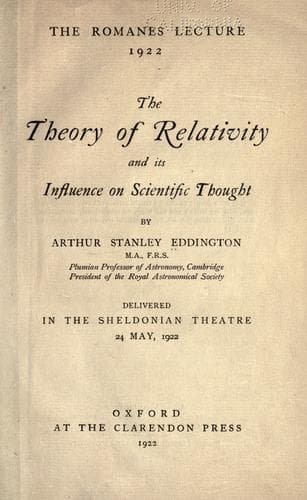
The theory of relativity and its influence on scientific thoughtEddington, Arthur Stanley, Sir
Philosophy
The theory of relativity and its influence on scientific thought
Eddington, Arthur Stanley, Sir
Relativity (Physics); Science -- Philosophy
Ptolemy on the earth and Copernicus on the sun are both contemplating
the same external universe. But their experiences are different, and it
is in the process of experiencing events that they become fitted into
the frame of space and time--the frame being different according to the
local circumstances of the observer who is experiencing them. That, I
take it, is Kant's doctrine, 'Space and time are forms of experience.'
The frame then is not in the world; it is supplied by the observer and
depends on him. And those relations of simplicity, which we seek when we
try to obtain a comprehension of how the universe functions, must lie in
the events themselves before they have been arbitrarily fitted into the
frame. The most we can hope for from any frame is that it will not have
distorted the simplicity which was originally present; whilst an
ill-chosen frame may play havoc with the natural simplicity of things.
We have seen that the simplicity of planetary motions was obscured in
Ptolemy's frame, and became apparent in Copernicus's frame. But for
ordinary terrestrial phenomena the position is reversed and Ptolemy's
frame allows their natural simplicity to become apparent. In
Copernicus's frame the most simple phenomena are brought about by highly
complicated processes which mutually cancel one another. Ordinary
objects contract and expand as they are moved about, and the changes are
concealed by an elaborate conspiracy in which all the quantities of
nature--electrical, optical, mechanical, gravitational--have joined. In
Copernicus's frame we have a great complication of description which has
no counterpart in anything occurring in the external world; because the
terms of our description refer to the irrelevant process of fitting into
the selected frame of space and time. This elaborate Copernican scheme
rather reminds one of the schemes of the White Knight--
But I was thinking of a plan
To dye one's whiskers green,
And always use so large a fan
That they could not be seen.
We do not deny the subtlety and the remarkable efficiency of the plan;
but we may be allowed to question whether it is the simplest
interpretation of the drab monotony of the face of nature presented to
us. The simple fact is that a terrestrial or Ptolemaic frame fits
naturally the terrestrial phenomena, and a solar or Copernican frame
fits the phenomena of the solar system; but we cannot make one frame
serve for both without introducing irrelevant, complications.
Public-domain text, read in full here on John Shaqi.
Reviews
Reviews
No reviews yet
Be the first to share your thoughts on this work.
Join the Discussion
Join the discussion
Sign in to leave a comment or review.
Sign InorCreate an account