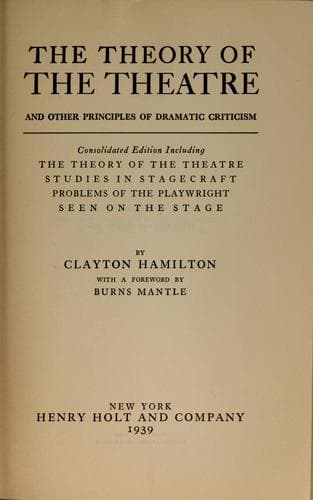
The Theory of the Theatre, and Other Principles of Dramatic CriticismHamilton, Clayton Meeker
History
The Theory of the Theatre, and Other Principles of Dramatic Criticism
Hamilton, Clayton Meeker
Drama -- History and criticism -- Theory, etc.; Theater
At the present day, a very large proportion of the contributions to the
theatre must be classed and judged as journalism. Such plays, for instance,
as _The Lion and the Mouse_ and _The Man of the Hour_ are nothing more or
less than dramatised newspapers. A piece of this sort, however effective it
may be at the moment, must soon suffer the fate of all things timely and
slip behind the times. Whenever an author selects a subject because he
thinks the public wants him to talk about it, instead of because he knows
he wants to talk about it to the public, his motive is journalistic rather
than literary. A timely topic may, however, be used to embody a truly
literary intention. In _The Witching Hour_, for example, journalism was
lifted into literature by the sincerity of Mr. Thomas's conviction that he
had something real and significant to say. The play became important
because there was a man behind it. Individual personality is perhaps the
most dateless of all phenomena. The fact of any great individuality once
accomplished and achieved becomes contemporary with the human race and
sloughs off the usual limits of past and future.
Whatever Mr. J.M. Barrie writes is literature, because he dwells isolate
amidst the world in a wise minority of one. The things that he says are of
importance because nobody else could have said them. He has achieved
individuality, and thereby passed out of hearing of the ticking of clocks
into an ever-ever land where dates are not and consequently epitaphs can
never be. What he utters is of interest to the public, because his motive
for speaking is private and personal. Instead of telling people what they
think that they are thinking, he tells them what they have always known but
think they have forgotten. He performs, for this oblivious generation, the
service of a great reminder. He lures us from the strident and factitious
world of which we read daily in the first pages of the newspapers, back to
the serene eternal world of little, nameless, unremembered acts of kindness
and of love. He educates the many, not by any crass endeavor to formulate
or even to mold the opinion of the public, but by setting simply before
them thoughts which do often lie too deep for tears.
The distinguishing trait of Mr. Barrie's genius is that he looks upon life
with the simplicity of a child and sees it with the wisdom of a woman. He
has a woman's subtlety of insight, a child's concreteness of imagination.
He is endowed (to reverse a famous phrase of Matthew Arnold's) with a sweet
unreasonableness. He understands life not with his intellect but with his
sensibilities. As a consequence, he is familiar with all the tremulous,
delicate intimacies of human nature that every woman knows, but that most
men glimpse only in moments of exalted sympathy with some wise woman whom
they love. His insight has that absoluteness which is beyond the reach of
intellect alone. He knows things for the unutterable woman's
reason,--"because...."
Public-domain text, read in full here on John Shaqi.
Reviews
Reviews
No reviews yet
Be the first to share your thoughts on this work.
Elsewhere in the archive
Join the Discussion
Join the discussion
Sign in to leave a comment or review.
Sign InorCreate an account