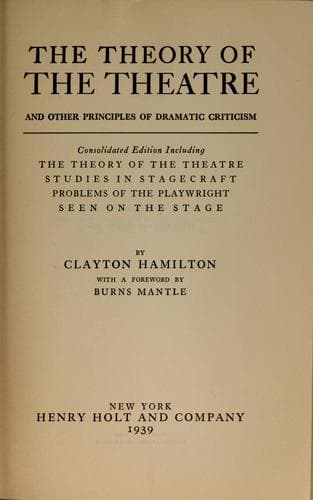
The Theory of the Theatre, and Other Principles of Dramatic CriticismHamilton, Clayton Meeker
History
The Theory of the Theatre, and Other Principles of Dramatic Criticism
Hamilton, Clayton Meeker
Drama -- History and criticism -- Theory, etc.; Theater
But with this feminine, intuitive understanding of humanity, Mr. Barrie
combines the distinctively masculine trait of being able to communicate the
things that his emotions know. The greatest poets would, of course, be
women, were it not for the fact that women are in general incapable of
revealing through the medium of articulate art the very things they know
most deeply. Most of the women who have written have said only the lesser
phases of themselves; they have unwittingly withheld their deepest and most
poignant wisdom because of a native reticence of speech. Many a time they
reach a heaven of understanding shut to men; but when they come back, they
cannot tell the world. The rare artists among women, like Sappho and Mrs.
Browning and Christina Rossetti and Laurence Hope, in their several
different ways, have gotten themselves expressed only through a sublime and
glorious unashamedness. As Hawthorne once remarked very wisely, women have
achieved art only when they have stood naked in the market-place. But men
in general are not withheld by a similar hesitance from saying what they
feel most deeply. No woman could have written Mr. Barrie's biography of his
mother; but for a man like him there is a sort of sacredness in revealing
emotion so private as to be expressible only in the purest speech. Mr.
Barrie was apparently born into the world of men to tell us what our
mothers and our wives would have told us if they could,--what in deep
moments they have tried to tell us, trembling exquisitely upon the verge of
the words. The theme of his best work has always been "what every woman
knows." In expressing this, he has added to the permanent recorded
knowledge of humanity; and he has thereby lifted his plays above the level
of theatric journalism to the level of true dramatic literature.
IX
THE INTENTION OF PERMANENCE
At Coney Island and Atlantic City and many other seaside resorts whither
the multitude drifts to drink oblivion of a day, an artist may be watched
at work modeling images in the sand. These he fashions deftly, to entice
the immediate pennies of the crowd; but when his wage is earned, he leaves
his statues to be washed away by the next high surging of the tide. The
sand-man is often a good artist; let us suppose he were a better one. Let
us imagine him endowed with a brain and a hand on a par with those of
Praxiteles. None the less we should set his seashore images upon a lower
plane of art than the monuments Praxiteles himself hewed out of marble.
This we should do instinctively, with no recourse to critical theory; and
that man in the multitude who knew the least about art would express this
judgment most emphatically. The simple reason would be that the art of the
sand-man is lacking in the Intention of Permanence.
Public-domain text, read in full here on John Shaqi.
Reviews
Reviews
No reviews yet
Be the first to share your thoughts on this work.
Elsewhere in the archive
Join the Discussion
Join the discussion
Sign in to leave a comment or review.
Sign InorCreate an account