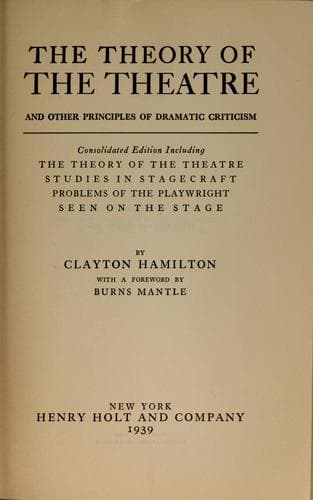
The Theory of the Theatre, and Other Principles of Dramatic CriticismHamilton, Clayton Meeker
History
The Theory of the Theatre, and Other Principles of Dramatic Criticism
Hamilton, Clayton Meeker
Drama -- History and criticism -- Theory, etc.; Theater
In the course of his glorious _Song of the Open Road_, Walt Whitman said,
"I and mine do not convince by arguments, similes, rhymes; we convince by
our presence"; and it has always seemed to me that this remark is
peculiarly applicable to dramatists and dramas. The primary purpose of a
play is to give a gathered multitude a larger sense of life by evoking its
emotions to a consciousness of terror and pity, laughter and love. Its
purpose is not primarily to rouse the intellect to thought or call the will
to action. In so far as the drama uplifts and edifies the audience, it does
so, not by precept or by syllogism, but by emotional suggestion. It teaches
not by what it says, but rather by what it deeply and mysteriously is. It
convinces not by its arguments, but by its presence.
It follows that those who think about the drama in relation to society at
large, and consider as a matter of serious importance the effect of the
theatre on the ticket-buying public, should devote profound consideration
to that subtle quality of plays which I may call their _tone_. Since the
drama convinces less by its arguments than by its presence, less by its
intellectual substance than by its emotional suggestion, we have a right to
demand that it shall be not only moral but also sweet and healthful and
inspiriting.
After witnessing the admirable performance of Mrs. Fiske and the members of
her skilfully selected company in Henrik Ibsen's dreary and depressing
_Rosmersholm_, I went home and sought solace from a reperusal of an old
play, by the buoyant and healthy Thomas Heywood, which is sweetly named
_The Fair Maid of the West_. _Rosmersholm_ is of all the social plays of
Ibsen the least interesting to witness on the stage, because the spectator
is left entirely in the dark concerning the character and the motives of
Rebecca West until her confession at the close of the third act, and can
therefore understand the play only on a second seeing. But except for this
important structural defect the drama is a masterpiece of art; and it is
surely unnecessary to dwell upon its many merits. On the other hand, _The
Fair Maid of the West_ is very far from being masterly in art. In structure
it is loose and careless; in characterisation it is inconsistent and
frequently untrue; in style it is uneven and without distinction. Ibsen, in
sheer mastery of dramaturgic means, stands fourth in rank among the world's
great dramatists. Heywood was merely an actor with a gift for telling
stories, who flung together upward of two hundred and twenty plays during
the course of his casual career. And yet _The Fair Maid of the West_ seemed
to me that evening, and seems to me evermore in retrospect, a nobler work
than _Rosmersholm_; for the Norwegian drama gives a doleful exhibition of
unnecessary misery, while the Elizabethan play is fresh and wholesome, and
fragrant with the breath of joy.
Public-domain text, read in full here on John Shaqi.
Reviews
Reviews
No reviews yet
Be the first to share your thoughts on this work.
Elsewhere in the archive
Join the Discussion
Join the discussion
Sign in to leave a comment or review.
Sign InorCreate an account