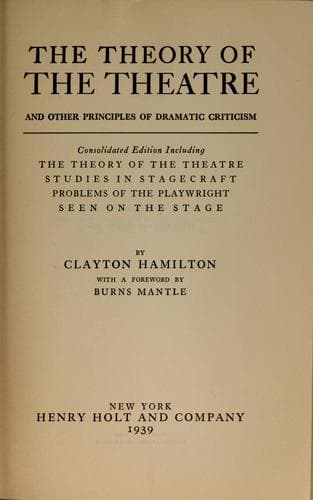
The Theory of the Theatre, and Other Principles of Dramatic CriticismHamilton, Clayton Meeker
History
The Theory of the Theatre, and Other Principles of Dramatic Criticism
Hamilton, Clayton Meeker
Drama -- History and criticism -- Theory, etc.; Theater
Of two plays equally true in content and in treatment, equally accomplished
in structure, in characterisation, and in style, that one is finally the
better which evokes from the audience the healthiest and hopefullest
emotional response. This is the reason why _Oedipus King_ is a better play
than _Ghosts_. The two pieces are not dissimilar in subject and are
strikingly alike in art. Each is a terrible presentment of a revolting
theme; each, like an avalanche, crashes to foredoomed catastrophe. But the
Greek tragedy is nobler in tone, because it leaves us a lofty reverence for
the gods, whereas its modern counterpart disgusts us with the inexorable
laws of life,--which are only the old gods divested of imagined
personality.
Slowly but surely we are growing very tired of dramatists who look upon
life with a wry face instead of with a brave and bracing countenance. In
due time, when (with the help of Mr. Barrie and other healthy-hearted
playmates) we have become again like little children, we shall realise that
plays like _As You Like It_ are better than all the _Magdas_ and the _Hedda
Gablers_ of the contemporary stage. We shall realise that the way to heal
old sores is to let them alone, rather than to rip them open, in the
interest (as we vainly fancy) of medical science. We shall remember that
the way to help the public is to set before it images of faith and hope and
love, rather than images of doubt, despair, and infidelity.
The queer thing about the morbid-minded specialists in fabricated woe is
that they believe themselves to be telling the whole truth of human life
instead of telling only the worser half of it. They expunge from their
records of humanity the very emotions that make life worth the living, and
then announce momentously, "Behold reality at last; for this is Life." It
is as if, in the midnoon of a god-given day of golden spring, they should
hug a black umbrella down about their heads and cry aloud, "Behold, there
is no sun!" Shakespeare did that only once,--in _Measure for Measure_. In
the deepest of his tragedies, he voiced a grandeur even in obliquity, and
hymned the greatness and the glory of the life of man.
Suppose that what looks white in a landscape painting be actually bluish
gray. Perhaps it would be best to tell us so; but failing that, it would
certainly be better to tell us that it is white than to tell us that it is
black. If our dramatists must idealise at all in representing life, let
them idealise upon the positive rather than upon the negative side. It is
nobler to tell us that life is better than it actually is than to tell us
that it is worse. It is nobler to remind us of the joy of living than to
remind us of the weariness. "For to miss the joy is to miss all," as
Stevenson remarked; and if the drama is to be of benefit to the public, it
should, by its very presence, convey conviction of the truth thus nobly
phrased by Matthew Arnold:
Public-domain text, read in full here on John Shaqi.
Reviews
Reviews
No reviews yet
Be the first to share your thoughts on this work.
Elsewhere in the archive
Join the Discussion
Join the discussion
Sign in to leave a comment or review.
Sign InorCreate an account