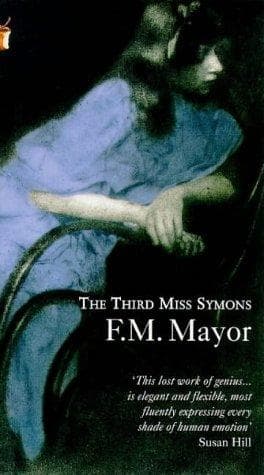
The Third Miss SymonsMayor, F. M. (Flora Macdonald)
General
The Third Miss Symons
Mayor, F. M. (Flora Macdonald)
England -- Social life and customs -- 19th century -- Fiction; Single women -- Fiction
Produced by Suzanne Shell and the Online Distributed
Proofreading Team at http://www.pgdp.net
THE THIRD
MISS SYMONS
F. M. Mayor
_With a Preface by John Masefield_
First published in Great Britain 1913
Copyright F. M. Mayor 1913
PREFACE
Miss Mayor's story is of a delicate quality, not common here, though
occurring at intervals, and always sure of a choice, if not very large,
audience among those who like in art the refined movement and the gentle
line. Her subject, like her method, is one not commonly chosen by women
writers; it is simply the life of an unmarried idle woman of the last
generation, a life (to some eyes) of wasted leisure and deep futility,
but common enough, and getting from its permitted commonness a
justification from life, who is wasteful but roughly just. Miss Mayor
tells this story with singular skill, more by contrast than by drama,
bringing her chief character into relief against her world, as it passes
in swift procession. Her tale is in a form becoming common among our
best writers; it is compressed into a space about a third as long as the
ordinary novel, yet form and manner are so closely suited that all is
told and nothing seems slightly done, or worked with too rapid a hand.
Much that is tiresome in the modern novel, the pages of analysis and of
comment, the long descriptions and the nervous pathology, are omitted by
Miss Mayor's method, which is all for the swift movement and against the
temptations to delay which obstruct those whose eyes are not upon life;
she condenses her opportunities for psychology and platitude into a
couple of shrewd lines and goes on with her story, keeping her freshness
and the reader's interest unabated. The method is to draw the central
figure rapidly past a succession of bright lights, keeping the lights
various and of many colours and allowing none of them to shine too long.
This comparatively passive creative method suits the subject; for her
heroine has the fate to be born in a land where myriads of women of her
station go passively like poultry along all the tramways of their
parishes; life is something that happens to them, it is their duty to
keep to the tracks, and having enough to eat and enough to put on
therewith to be content, or if not content, sour, but in any case to
seek no further over the parochial bounds. Her heroine, born into such a
tradition, continues in it, partly by the pressure of custom and family
habit, both always very powerful and often deadly in this country, and
partly from a want of illumination in herself, her instructors, and in
the life about her. The latter want is the fatal defect in her: it is
the national defect, "the everlasting prison remediless" into which so
many thousands of our idle are yearly thrown; it is from this that she
really suffers; it is to this that she succumbs, while the ivy of her
disposition grows over and smothers whatever light may be in her. Like
Public-domain text, read in full here on John Shaqi.
Reviews
Reviews
No reviews yet
Be the first to share your thoughts on this work.
Join the Discussion
Join the discussion
Sign in to leave a comment or review.
Sign InorCreate an account