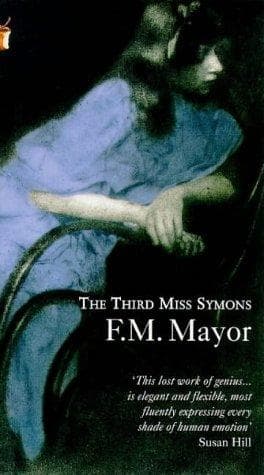
The Third Miss SymonsMayor, F. M. (Flora Macdonald)
General
The Third Miss Symons
Mayor, F. M. (Flora Macdonald)
England -- Social life and customs -- 19th century -- Fiction; Single women -- Fiction
water in flood-time revolving muddily over the choked outlet, her life
revolves over the evil in it without resolution or escape; her brain,
like so many of the brains in civilization, is but slightly drawn upon
or exercised; she is not so much wasted as not used. Having by fortune
and tradition nothing to do, she remains passive till events and time
make her incapable of doing, while the world glitters past in its
various activity, throwing her incapacity into ever stronger relief,
till her time is over and the general muddle is given a kind of
sacredness, even of beauty, by ceasing. She has done nothing but live
and been nothing but alive, both to such passive purpose that the
ceasing is pitiful; and it is by pushing on to this end, instead of
shirking it, and by marking the last tragical fact which puts a dignity
upon even the meanest being, that Miss Mayor raises her story above the
plane of social criticism, and keeps it sincere. A lesser writer would
have been content with less, and having imagined her central figure
would have continued to stick pins into it, till the result would have
been no living figure, but a record of personal judgments, perhaps even,
as sometimes happens, of personal pettiness, a witch's waxen figure
plentifully pricked before the consuming flame. Miss Mayor keeps on the
side of justice, with the real creators, to whom there is nothing simple
and no one unmixed, and in this way gets beauty, and through beauty the
only reality worth having.
In a land like England, where there is great wealth, little education
and little general thought, people like Miss Mayor's heroine are common;
we have all met not one or two but dozens of her; we know her emptiness,
her tenacity, her futility, savagery and want of light; all circles
contain some examples of her, all people some of her shortcomings; and
judgment of her, even the isolation of her in portraiture, is dangerous,
since the world does not consist of her and life needs her. In life as
in art those who condemn are those who do not understand; and it is
always a sign of a writer's power, that he or she keeps from direct
praise or blame of imagined character. Miss Mayor arrives at an
understanding of her heroine's character by looking at her through a
multitude of different eyes, not as though she were her creator, but as
if she were her world, looking on and happening, infinitely active and
various, coming into infinite contrast, not without tragedy, but also
never without fun. The world is, of course, the comparatively passive
feminine world, but few modern books (if any) have treated of that
world so happily, with such complete acceptance, unbiassed and
unprejudiced, yet with such selective tact and variety of gaiety. She
comes to the complete understanding of Henrietta by illuminating all the
facets in her character and all the threads of her destiny, and this is
an unusual achievement, made all the more remarkable by a brightness and
Public-domain text, read in full here on John Shaqi.
Reviews
Reviews
No reviews yet
Be the first to share your thoughts on this work.
Join the Discussion
Join the discussion
Sign in to leave a comment or review.
Sign InorCreate an account