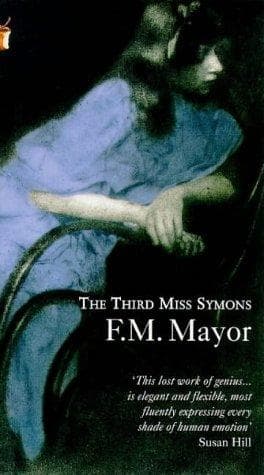
The Third Miss SymonsMayor, F. M. (Flora Macdonald)
General
The Third Miss Symons
Mayor, F. M. (Flora Macdonald)
England -- Social life and customs -- 19th century -- Fiction; Single women -- Fiction
But for her complexion there was nothing very taking in Henrietta.
Whoever travels in the Tube must have seen many women with dark-brown
hair, brown eyes, and too-strongly-marked eyebrows; their features are
neither good nor bad; their whole aspect is uninteresting. They have no
winning dimples, no speaking lines about the mouth. All that one can
notice is a disappointed, somewhat peevish look in the eyes. Such was
Henrietta. The fact that she had not been much wanted or appreciated
hitherto began to show now she was eighteen. She was either shy and
silent, or talked with too much positiveness for fear she should not be
listened to; so that though she was not a failure at dances and managed
to find plenty of partners, there were none of the interesting episodes
that were continually occurring on Louie's evenings, and for a year or
two her hopes were not realized. The Prince Charming she was waiting for
came not.
Sometimes Louie was away on visits, and Henrietta went to dances
without her. At one of these, as usual a strange young man was
introduced. There was nothing special about him. They had the usual talk
of first dances. Then he asked for a second, then for a third. He was
introduced to her mother. She asked him to call. He came. He talked
mostly to her mother, but it was clear that it was Henrietta he came to
see. Another dance, another call, and meetings at friends' houses, and
wherever she was he wanted to be beside her. It was an exquisitely happy
month. He was a commonplace young man, but what did that matter? There
was nothing in Henrietta to attract anyone very superior. And perhaps
she loved him all the more because he was not soaring high above her,
like all her previous divinities, but walking side by side with her.
Yes, she loved him; by the time he had asked her for the third dance she
loved him. She did not think much of his proposing, of their marrying,
just that someone cared for her. At first she could not believe it, but
by the end of the month the signs clearly resembled those of Louie's
young men. Flowers, a note about a book he had lent her, a note about a
mistake he had made in his last note; she was sure he must care for
her. The other girls at the dances noticed his devotion, and asked
Henrietta when it was to be announced. She laughed off their questions,
but they gave her a thrill of delight. All must be well.
And if they had married all would have been well. There might have been
jars and rubs, with Henrietta's jealous disposition there probably would
have been, but they would have been as happy as the majority of married
couples; she would have been happier, for to many people, even to some
women, it is not, as it was to her, the all-sufficing condition of
existence to love and be loved.
Public-domain text, read in full here on John Shaqi.
Reviews
Reviews
No reviews yet
Be the first to share your thoughts on this work.
Join the Discussion
Join the discussion
Sign in to leave a comment or review.
Sign InorCreate an account