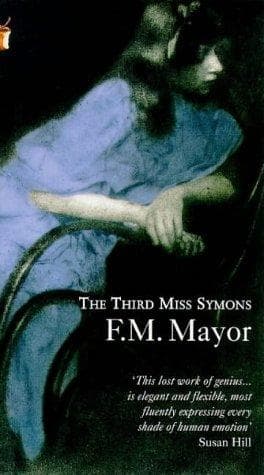
The Third Miss SymonsMayor, F. M. (Flora Macdonald)
General
The Third Miss Symons
Mayor, F. M. (Flora Macdonald)
England -- Social life and customs -- 19th century -- Fiction; Single women -- Fiction
She very rarely received good advice in her life, and now that she had
got it, she made no use of it. If she had, it might have changed the
whole of her future. But from henceforth, on birthdays, New Year's Eves,
and other anniversaries, when she took stock of herself and her
character, she ignored her temper, and would not count it as a factor
that could be modified. There were others as lonely as herself at
school, there are always many lonely in a community; but she did not
realize this, and felt herself exceptional. She imagined that she was
overwhelmed with misery at this time, but really the life was so busy,
and she was so fond of the lessons, and did them so well, that she was
not to be pitied as much as she thought.
It was clear she was to be lonely at school and lonely at home. Where
was she to find relief? There was a supply of innocuous story-books for
the perusal of Mrs. Marston's pupils on Saturday half-holidays,
innocuous, that is to say, but for the fact that they gave a completely
erroneous view of life, and from them Henrietta discovered that heroines
after the sixteenth birthday are likely to be pestered with adorers. The
heroines, it is true, were exquisitely beautiful, which Henrietta knew
she was not, but from a study of "Jane Eyre" and "Villette" in the
holidays, Charlotte Bronte was forbidden at school owing to her excess
of passion, Henrietta realized that the plain may be adored too, so she
had a modest hope that when the magic season of young ladyhood arrived,
a Prince Charming would come and fall in love with her. This hope filled
more and more of her thoughts, and all her last term, when other girls
were crying at the thought of leaving, she was counting the days to her
departure.
CHAPTER III
Henrietta was eighteen when she left school. Minna and Louie had gone
two or three years before, and by the time Henrietta came home, Minna
was engaged to be married. There was nothing particular about Minna. She
was capable, and clear-headed, and rather good-looking, and could dress
well on a little money. She was not much of a talker, but what she said
was to the point. On these qualifications she married a barrister with
most satisfactory prospects. They were both extremely fond of one
another in a quiet way, and fond they remained. She was disposed of
satisfactorily.
Louie was prettier and more lively. She was having a gay career of
flirtations, when Henrietta joined her. She did not at all want a
younger sister, particularly a sister with a pretty complexion. Three
years of parties had begun to tell on her own, which was of special
delicacy. She and Henrietta had never grown to like one another, and now
there went on a sort of silent war, an unnecessary war on Louie's side,
for she had a much greater gift with partners than Henrietta, and her
captives were not annexed.
Public-domain text, read in full here on John Shaqi.
Reviews
Reviews
No reviews yet
Be the first to share your thoughts on this work.
Join the Discussion
Join the discussion
Sign in to leave a comment or review.
Sign InorCreate an account