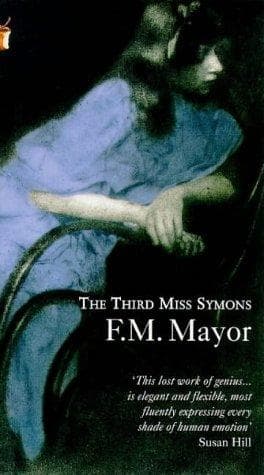
The Third Miss SymonsMayor, F. M. (Flora Macdonald)
General
The Third Miss Symons
Mayor, F. M. (Flora Macdonald)
England -- Social life and customs -- 19th century -- Fiction; Single women -- Fiction
quickness of mind which give delightful life to a multitude of incidents
which are in themselves new to fiction. Her touch upon all her world is
both swift and unerring; but the great charm of her work is its
brightness and unexpectedness; it lights up so many little unsuspected
corners in a world that is too plentifully curtained.
JOHN MASEFIELD, 1913
THE THIRD MISS SYMONS
CHAPTER I
Henrietta was the third daughter and fifth child of Mr. and Mrs. Symons,
so that enthusiasm for babies had declined in both parents by the time
she arrived. Still, in her first few months she was bound to be
important and take up a great deal of time. When she was two, another
boy was born, and she lost the honourable position of youngest. At five
her life attained its zenith. She became a very pretty, charming little
girl, as her two elder sisters had done before her. It was not merely
that she was pretty, but she suddenly assumed an air of graciousness and
dignity which captivated everyone. Some very little girls do acquire
this air: what its source is no one knows. In this case certainly not
Mr. and Mrs. Symons, who were particularly clumsy. Etta, as she was
called, was often summoned from the nursery when visitors came; so were
Minna and Louie her elder sisters, but all the ladies wanted to talk to
Etta. Minna and Louie had by this time, at nine and eleven, advanced to
the ugly, uninteresting stage, and they owed Henrietta a grudge because
she had annexed the petting that used to fall to them. They had their
revenge in whispering interminable secrets to one another, of which Etta
could hear stray sentences. "Ellen says she knows Arthur was very
naughty, because ... But we won't tell Etta." She was very susceptible
to notice, and the petting was not good for her.
When she was eight her zenith was past, and her plain stage began. Her
charm departed never to return, and she slipped back into
insignificance. At eight she could no longer be considered a baby to
play with, and a good deal of fault-finding was deemed necessary to
counteract the previous spoiling. In Henrietta's youth, sixty years ago,
fault-finding was administered unsparingly. She did not understand why
she was more scolded than the others, and decided that it was because
Ellen and Miss Weston and her mother had a spite against her.
Mrs. Symons was not fond of children, and throughout Henrietta's
childhood she was delicate, so that Henrietta saw very little of her.
Her chief recollections of her mother were of scoldings in the
drawing-room when she had done anything specially naughty.
Public-domain text, read in full here on John Shaqi.
Reviews
Reviews
No reviews yet
Be the first to share your thoughts on this work.
Join the Discussion
Join the discussion
Sign in to leave a comment or review.
Sign InorCreate an account