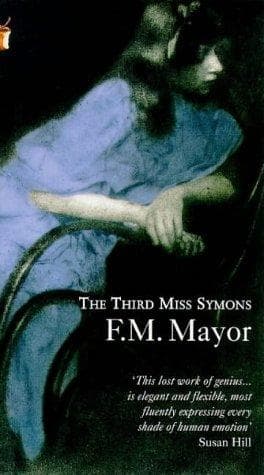
The Third Miss SymonsMayor, F. M. (Flora Macdonald)
General
The Third Miss Symons
Mayor, F. M. (Flora Macdonald)
England -- Social life and customs -- 19th century -- Fiction; Single women -- Fiction
When Henrietta saw more of her stepmother to be, she had in honesty to
own that she liked her. She was not only very attractive, but she was so
thoroughly nice and kind, so intent on making people happy, so entirely
without airs of patronage, and Henrietta could see how everybody warmed
under her smile.
Henrietta had settled that she would not live at home after the
marriage. Neither she nor her father could forget the letter, it was
better that they should part. She had again asked his forgiveness, but
neither felt at ease with the other.
She stayed for a few weeks after Mr. and Mrs. Symons came back from the
honeymoon, and saw almost with consternation, how the spirit of the
house changed. It became peaceful, cordial, harmonious; it would not
have been known for the same house. The whole household liked Mrs.
Symons; even her own dog deserted Henrietta. It was not that she was
ousted from her place, it was that Mrs. Symons created a place, which
never had been hers. She had had no idea in all these twelve years how
little she had made herself liked. She had had her chance, her one great
chance, in life, and she had missed it.
When she went away, there were kind good wishes for her prosperity,
interest in her plans, many hopes that she would visit them, but no
regret; with a clearness and honesty of sight she unfortunately
possessed she realized that--no regret.
What was the use of twelve years in which she had sincerely tried to do
her best, if she had not built up some little memorial of affection? It
was the old complaint of all her life, "I am not wanted." The anguish
she had shared with Evelyn and her husband had been much sharper, but in
the midst of it there had been consolation in the exquisite union they
had felt with the children and with one another. Here there was nothing
to cheer her; there is not much consolation when one fails where it
seems quite easy for others to succeed.
Now that it became evident that she would be so little missed, she was
in haste to get the parting over and be gone. But her unadventurous
spirit shrank from going out in the world to manage by itself. She was
very doubtful what she should do. She would not have been welcomed by
Minna or Louie, even if she had wished to live with them. Her second
brother was in some inaccessible foreign place. Evelyn and Herbert were
also far out of reach. He had exchanged into a regiment which was
quartered at Halifax, in Canada.
But the distance, however great, might have been faced, if she had
not had a miserable quarrel with Herbert. It began with some
misunderstanding about the tombstone on the youngest little girl's
grave, to which Henrietta had wished to contribute. She had written to
Evelyn from the Riviera in all the soreness of worn-out nerves and grief
from which the sublimity has gone. The very fact that they had been
drawn so close to one another made her specially irritable to Evelyn.
After one or two of her letters, an answer came from Herbert:
Public-domain text, read in full here on John Shaqi.
Reviews
Reviews
No reviews yet
Be the first to share your thoughts on this work.
Join the Discussion
Join the discussion
Sign in to leave a comment or review.
Sign InorCreate an account