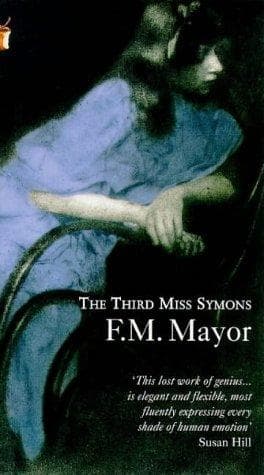
The Third Miss SymonsMayor, F. M. (Flora Macdonald)
General
The Third Miss Symons
Mayor, F. M. (Flora Macdonald)
England -- Social life and customs -- 19th century -- Fiction; Single women -- Fiction
"Evelyn is very ill from all she has been through, and the doctor says
it is most important that she should be kept from every sort of worry.
She was so much distressed at your last letter, and answering you took
so much out of her, that I have taken the liberty of keeping this one
from her. You have no right to write to her in this way, and I must ask
you to drop all correspondence for the present if your letters are to be
in the same strain."
Henrietta declared that he was trying to come between her and her
sister, and that if that was the case she should never trouble them
again. She did not write at all for several weeks, then she felt
remorseful, but Herbert could not forgive her. He wrote coldly that
Evelyn was still so unhinged as to be incapable of receiving letters
without undue excitement.
CHAPTER VII
Even now, when there is a certain amount of choice and liberty, a woman
who is thrown on her own resources at thirty-nine, with no previous
training, and no obvious claims and duties, does not find it very easy
to know how to dispose of herself. But a generation ago the problem was
far more difficult. Henrietta was well off for a single woman, but she
was incapable, and not easy to get on with. She would have thought it
derogatory to do any form of teaching--teaching, the natural refuge of a
workless woman.
Three or four courses presented themselves. First, philanthropy. She was
not really more philanthropic than she had been at twenty, when her aunt
had described to her the happiness of living for others. But she felt at
nearly forty that charitable work was a reasonable way of filling up her
time, on the whole, the most reasonable.
She never had had much to do with poor people. Mrs. Symons had helped
the charwoman, and the gardener, and the driver from the livery-stables,
when they were in special difficulties, and Henrietta had continued to
do so, and had had her hour at the hospital. That was all. There were
the servants, of course, but with the exception of Ellen she looked on
servants more as machines made for her convenience, liable to get out of
order unless they were constantly watched.
Entirely without enthusiasm, and with a dreary fighting against her lot,
she made inquiries among her acquaintances as to where she might find
charitable work. At length somebody knew somebody, who knew somebody who
was working in London under a clergyman. After further inquiries it was
found that the somebody was a lady, who would be very glad if Henrietta
would come and live with her, while she saw how she liked the work.
Public-domain text, read in full here on John Shaqi.
Reviews
Reviews
No reviews yet
Be the first to share your thoughts on this work.
Join the Discussion
Join the discussion
Sign in to leave a comment or review.
Sign InorCreate an account