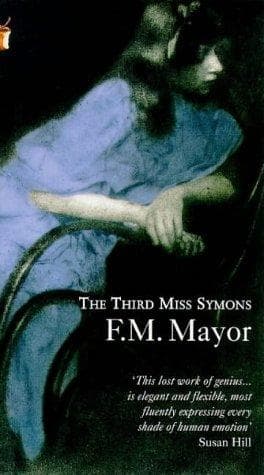
The Third Miss SymonsMayor, F. M. (Flora Macdonald)
General
The Third Miss Symons
Mayor, F. M. (Flora Macdonald)
England -- Social life and customs -- 19th century -- Fiction; Single women -- Fiction
His awkwardness and distress almost disarmed her, but she had felt his
snubs, and at nearly forty she was not going to be encouraged like a
child. So that though for many reasons she longed to stay, she answered:
"Thank you, it was a purely temporary arrangement; I have other plans."
As she walked home she wondered what the other plans were.
When in doubt, go abroad. She went abroad again for three months. Her
companion was picked up from nowhere in particular, an odd woman like
herself.
They went to Italy. Neither of them cared in the smallest degree for
sculpture, architecture, painting, archaeology, poetry, history,
politics, scenery, languages, or foreigners. These last Henrietta
regarded as inferior Anglo-Indians regard natives, referring to them
always as "those wretches."
Like most women she loved certain aspects in her garden at home, which
were connected with incidents in her life. There was a path bordered by
roses, along which they had walked when Evelyn announced her engagement,
and a special old apple-tree reminded her of the night her mother died.
But to go and admire what Baedeker called a magnificent _coup d'oeil_
was no sort of pleasure to her.
However, she and Miss Gurney had one unending amusement, which Italy is
peculiarly able to supply. They could make short visits to different
towns, and fit sights into their days, as one fits pieces into a puzzle.
Henrietta found this sport most satisfying.
CHAPTER VIII
Just as they were getting tired of tables d'hote dinners, there came to
their hotel an enthusiast for learning. It was before the days of
women's colleges; they were established, but frequented only by
pioneers, in whose ranks no Henriettas are to be found. But courses of
lectures were so ordinary that not even the most timid could look
askance at them. As philanthropy had failed, and no one could pretend
that art could be a resource for Henrietta,--her career of sketches and
two part-songs had been phenomenally short (invaluable as it has proved
itself for many Englishwomen suffering from her complaint)--everything
pointed to study as the next solution on the list.
Study. Henrietta had not read a book which required any mental exertion
since her dozen chapters of "I Promessi Sposi," fifteen years ago.
Still, the lectures sounded pleasant to her; they were a novelty, they
were--she could not think of anything else they were--a novelty must be
their claim to distinction.
She and the travelling friend found a boarding-house near the
lecture-room. London and the lodgings both looked dismal after the
brightness of abroad, but they were excited at the prospect of
establishing themselves on their own account. It was enterprising, but
not too enterprising.
Public-domain text, read in full here on John Shaqi.
Reviews
Reviews
No reviews yet
Be the first to share your thoughts on this work.
Join the Discussion
Join the discussion
Sign in to leave a comment or review.
Sign InorCreate an account