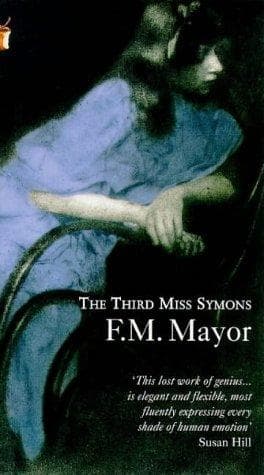
The Third Miss SymonsMayor, F. M. (Flora Macdonald)
General
The Third Miss Symons
Mayor, F. M. (Flora Macdonald)
England -- Social life and customs -- 19th century -- Fiction; Single women -- Fiction
It certainly was true that Henrietta did not do much good, and no one
was more aware of this than herself. She stood outside the community,
and looked in at them like a hungry beggar at a feast. How she envied
their happiness, but she did not feel that she was, or ever could be, a
partaker with them. As months passed on, she drew no nearer to them.
They were all so busy, so strong in their union with one another, they
did not seem to have time to stretch out a friendly hand to one who was
at least as much in need of it as Mrs. Wilkins.
The lady she lived with found her trying. "A very trying person" was the
phrase that went the round about her, "always criticizing small
arrangements about the meals and the housekeeping," for Henrietta could
not at first reconcile herself to having no authority to exert, and this
jangling was not a good preparation for sisterly sympathy towards her.
The Vicar's wife might have become friends with her, but during the six
months Henrietta was in the parish Mrs. Wharton was ill and hardly able
to see anyone. Besides, she was shy, and the only time that Henrietta
came to tea they never succeeded in getting beyond a comparison of
foreign hotels.
Henrietta would have liked to confide her troubles, but as she grew
older she had become a great deal more reserved, and also these troubles
she was ashamed to speak of. To think that she had made her own sister,
ill and miserable as she was, more ill and more miserable, she could not
forgive herself; she was even harder on herself than Herbert had been.
As Mr. Wharton had said, it was useless engaging in this arduous work
when her heart was elsewhere. When her six months of trial came to an
end, it was clear that the only thing for her was to go. No one could
pretend they were sorry, and as everyone imagined she was glad, there
seemed no reason to disguise their feelings. They would have been
surprised if they had known her thoughts as she sat at the evening
service on her last Sunday. "Whatever I do, I fail; what is the use of
my living? Why was I born?"
She said to Mr. Wharton in her farewell interview: "I know I have been
very stupid at learning what was to be done, and I have not been willing
to take advice. Now I look back, I see the mistakes I have made, and I
have done harm instead of good. I want to give you"--she named a large
sum considering the size of her income--"to spend as you think right, I
hope that may help to make amends. I am very sorry."
He heard a quiver in her voice, and the dislike and irritation he had
felt all the six months faded away.
"This is much too generous of you," he stammered. "It is my fault, all
my fault. I have been so irritable, I haven't made allowances. My wife
tells me of it constantly. I wish you would forgive me and give us
another chance. Stay six months longer."
Public-domain text, read in full here on John Shaqi.
Reviews
Reviews
No reviews yet
Be the first to share your thoughts on this work.
Join the Discussion
Join the discussion
Sign in to leave a comment or review.
Sign InorCreate an account