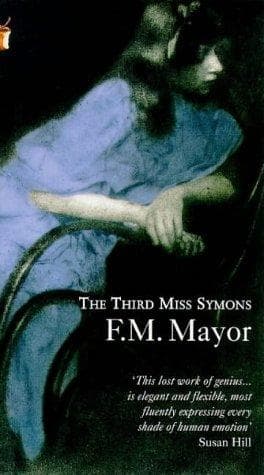
The Third Miss SymonsMayor, F. M. (Flora Macdonald)
General
The Third Miss Symons
Mayor, F. M. (Flora Macdonald)
England -- Social life and customs -- 19th century -- Fiction; Single women -- Fiction
If she had been one of two or one of three in a present-day family she
would have been more precious. But as one of four daughters--another
girl was born when she was eight--she was not much wanted. Mr. Symons
was a solicitor in a country town, and the problem of providing for his
seven, darkened the years of childhood for the whole Symons family. The
children felt that their parents found them something of a burden, and
in those days there was no cult of childhood to soften the hard reality.
The two older boys had a partnership together, into which they
occasionally admitted Minna and Louie. Minna and Louie had, beside their
secrets, a friend named Rosa. Harold, the youngest boy, did not want any
person--only toy engines. He and Etta should have been companions, but
he said she cried and told tales, though she told no more tales than he
did.
A large family should be such a specially happy community, but it
sometimes occurs that there is a girl or boy who is nothing but a middle
one, fitting in nowhere. So it was with Henrietta, till the youngest
child was born.
Unfortunately she had an almost morbid longing, unusual in a child, to
be loved and of importance. Now she would have given anything to have
heard Minna and Louie's secrets, not for the sake of the secrets, but as
a sign that she was thought worthy of confidence. She ran everyone's
errands continually, but she broke the head off Arthur's carnation as
she was bringing it from his bedroom to the garden, and she let out
William's secret, which he had told her in an unusual fit of affability,
in order that she might curry favour with Minna. This infuriated
William, and did not conciliate Minna. She grew fast and was a little
delicate. It made her irritable, but her brothers and sisters, who were
all growing with great regularity, could not be expected to understand
delicacy. She always said she was sorry after she had been cross, but
they, who did not have tempers, could not see that that made things any
better.
In her loneliness she made for herself, like many other forlorn
children, a phantom friend. It was a little girl two years older than
she was, for Henrietta preferred to look up, and be herself in an
inferior position. For this reason she did not much care for dolls,
where she was decidedly the superior. She called her friend Amy. Amy
slept with her, helped her with her lessons, told her secrets
perpetually, and grumbled about the other children.
Public-domain text, read in full here on John Shaqi.
Reviews
Reviews
No reviews yet
Be the first to share your thoughts on this work.
Join the Discussion
Join the discussion
Sign in to leave a comment or review.
Sign InorCreate an account