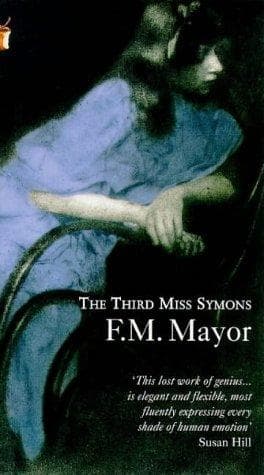
The Third Miss SymonsMayor, F. M. (Flora Macdonald)
General
The Third Miss Symons
Mayor, F. M. (Flora Macdonald)
England -- Social life and customs -- 19th century -- Fiction; Single women -- Fiction
"Dear Herbert, he is so good--I can't tell you how good he is to me--but
he never will mention them. First of all I was so ill, I couldn't stand
talking of them, but now I can, and I do long for it. He doesn't forget
them, I know, but I think men live more in the present than we do; and
he has his work, which absorbs him very much, and it isn't quite the
same for a man. And then they were so delicate, particularly Madeline,
that I was wrapped up in them all their lives; and they were so small,
he couldn't see much of them."
"Do you feel that you could tell me about them?"
"Yes, I should like to."
They talked far into the night. Herbert was away, so that there was no
one to stop them, and when at last the dawn drove them to bed, Evelyn
said: "I can't tell you how much good you've done me. I seem to have
been living for this for fifteen years."
They neither of them slept at all that night. Both were full of remorse,
but Henrietta's was the bitterest. The life which had seemed to do quite
well enough all these years, suddenly appeared to her as it was. She
contrasted her present self with the little girl Ellen had known. Like
Jane Eyre, she "drew her own picture faithfully without softening one
defect. She omitted no hard line, smoothed away no displeasing
irregularity." She had squabbled, that very afternoon, if it is possible
to squabble when only one party does the squabbling, all the way down to
Ellen's about various quite unimportant dates in William's life. The
incident was almost as much a part of her day's routine as eating her
breakfast. Now it seemed to her a manifestation of the degradation into
which she had fallen.
The power and vividness of her memory, magnified ten times by the
mysterious agency of midnight, brought back the words of advice of Emily
Mence, of Minna, and of her aunt, just as if they had been spoken last
week. She had entirely forgotten them for years. Now they kept rushing
through her head hour after hour.
Before breakfast Evelyn came into her room, her eyes shining with
agitation, and looking so flushed that Henrietta saw what need there had
been for Herbert's caution.
"Etty," she said, "I've been thinking all night; I can't bear your
living in this horrible way: no home, away by yourself, so that we see
nothing of you. Come and live here, live with us. We shan't interfere
with you; you shall come and go as you like. Or live in the village,
there is a dear little house just made for you. Only come and be near
us."
Henrietta was sorely tempted, it was a great sacrifice to say no. But
she knew that Herbert only tolerated her for Evelyn's sake, and that the
boys, rather spoilt and self-important, found her a nuisance. She knew
also that she could not trust herself to be pleasant and good-tempered.
If she came, it would not be for Evelyn's happiness. So she refused,
and even in her fervour of love for Henrietta, Evelyn could not help
realizing it was best that she should.
Public-domain text, read in full here on John Shaqi.
Reviews
Reviews
No reviews yet
Be the first to share your thoughts on this work.
Join the Discussion
Join the discussion
Sign in to leave a comment or review.
Sign InorCreate an account