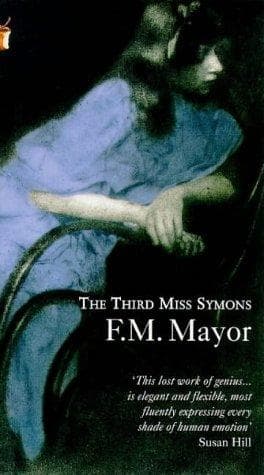
The Third Miss SymonsMayor, F. M. (Flora Macdonald)
General
The Third Miss Symons
Mayor, F. M. (Flora Macdonald)
England -- Social life and customs -- 19th century -- Fiction; Single women -- Fiction
At the same time that talk was a turning-point in Henrietta's life. She
never felt after it that she was completely unwanted. Although she would
not live with Evelyn, she thought she might justifiably come and be much
nearer her, and she gave up the roving life and returned to England. It
had in fact satisfied her, only because she had felt so uncared-for that
she became insignificant even to herself.
Where should she live? She knew that every place where she had relations
would not do, but this only ruled out four of the towns of the United
Kingdom. It must be a town; on that point she was clear. As she cared
for none of the special advantages of a town, its more lively society,
its greater opportunities for entertainment and intellectual interests,
she was particularly insistent that she could not do without them. What
she wanted was a house with room for herself, two maids, and a couple of
visitors. Such a house is to be found in tens and hundreds everywhere.
She went round and round England in a fruitless search.
As a _pension habituee_ the whole arrangement of her life had been
taken out of her hands; even her clothes had been settled for her by one
of those octopus London firms which like to reduce their customers to
dummies; and her transit from hotel to hotel, and from English visits
back to hotels, had become a mere automatic process. She had not made a
decision for so many years that though her nieces and nephews were witty
over her vacillation, and declared that she enjoyed being a nuisance, it
was a fact that she was trying her best to be sensible and competent.
She, with no go-between, no protector, must determine which was most
important--gravel soil or southern aspect. She felt as she had felt
years ago, when she wrote her paper for Professor Amery, only ten times
more bewildered, almost delirious.
Of course, her nieces constantly talked her over, shaking their heads
and saying: "If only Aunt Etta would let us." But however weak she was,
she was firm in this: she would _not_ be helped. The outward sign of her
bewilderment was extreme crossness, particularly to Evelyn, who was
allowed to accompany her in her search, and to hear her remarks without
making any suggestions. "I will thank you to let me decide about my own
house by myself." They had examined nine houses that day, and were both
almost weeping with exhaustion.
Evelyn could not help feeling exasperated, but when Etta stumbled the
moment after from sheer nervousness, and Evelyn caught hold of her hand,
she realized from its hot trembling grasp how hard it is to come back to
life again.
Public-domain text, read in full here on John Shaqi.
Reviews
Reviews
No reviews yet
Be the first to share your thoughts on this work.
Join the Discussion
Join the discussion
Sign in to leave a comment or review.
Sign InorCreate an account