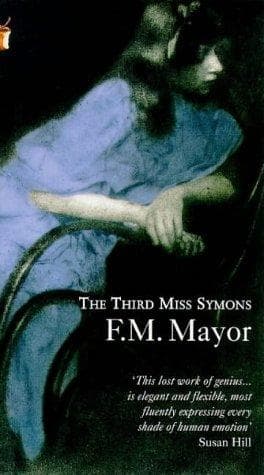
The Third Miss SymonsMayor, F. M. (Flora Macdonald)
General
The Third Miss Symons
Mayor, F. M. (Flora Macdonald)
England -- Social life and customs -- 19th century -- Fiction; Single women -- Fiction
Henrietta would probably never have found the right spot, if a timely
attack of rheumatism had not persuaded her to fix on Bath. When she had
settled into her house at last, she hated it. She dismissed five
servants in two months. She was so dull, no one called; Bath was so
cold. If only she could let her house and go abroad for the winter.
Happily no suitable tenant appeared, and gradually Bath grew into a
habit and she became resigned. But it was long, very long, before she
would own that she liked it.
CHAPTER XII
And now a happier and more useful course of life began. Henrietta had
just enough rheumatism to take a course of waters sometimes. She found a
doctor who had a great _flair_ for elderly ladies; he knew when to bully
them, when to flatter them, and when to neglect them. He and the waters
made a centre round which the rest of her interests might group
themselves. Church. She found a vicar with nothing of Mr. Wharton's
enthusiasm and loftiness of aim, but with a greater realization of
people's capacities. He too had made a study of elderly ladies, who are
always such an important branch of congregations. He could see that what
Miss Symons was in his drawing-room, touchy, incompetent, and snappish
she would be in any work she did in the parish. But he was also made to
see her extreme generosity, of which she herself was entirely
unconscious. He liked and was touched by her humility. "Oh no, don't
trouble about asking me, Mr. Vaughan, nobody will want to talk to a dull
person like me. Get some nice young men for the girls, if you can." "No,
I can't have that pretty Miss Allan helping at my stall, I can get along
very well by myself. I shall bring Annie; we can manage together."
The poor people, of course, did not like her, for as she grew older she
was more convinced than ever that the lower orders must be constantly
reproved. But poor people are very magnanimous, and they were sure of a
good many presents. She was also for ever bickering with her servants,
but "poor old lady" as they said, "she's getting on now, it makes her
worry," and she found in Annie one who knew how to give at least as good
as she got. Horror of being defrauded by servants and tradespeople was a
great resource, and though she continually deplored the pleasure of life
abroad, these years of muddling in and out of her house, her garden, and
her shops, were probably the happiest in her life.
A certain conversation contributed not a little to this new happiness.
She was at a tea-party, for once she had been admitted into the circle
of tea-parties, she became much absorbed in them, and she and a
neighbour were tracing an attack of influenza from its source to its
decline, when Henrietta's hostess came up to her.
"I want to introduce you to Mrs. Manson," said she. "Mrs. Manson is a
cousin of that Mr. Dockerell you told me you knew, Miss Symons."
Public-domain text, read in full here on John Shaqi.
Reviews
Reviews
No reviews yet
Be the first to share your thoughts on this work.
Join the Discussion
Join the discussion
Sign in to leave a comment or review.
Sign InorCreate an account