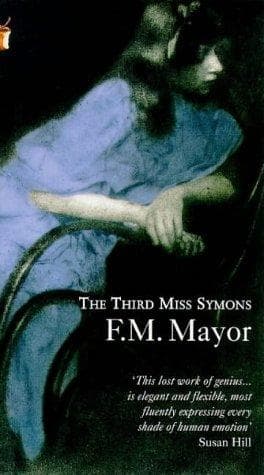
The Third Miss SymonsMayor, F. M. (Flora Macdonald)
General
The Third Miss Symons
Mayor, F. M. (Flora Macdonald)
England -- Social life and customs -- 19th century -- Fiction; Single women -- Fiction
Jessie Winsley repeated this speech to Henrietta, little thinking what
anguish it would cause. Henrietta had very little pride, very little
proper pride some people might have said; she did not at all mind giving
a great deal more than she got. But this speech, which was not, after
all, so very malignant, drove her to despair. She went to Miranda, who
hugged her, and said: "Old cat! barbaric old cat! Never think of her
again, she isn't worth it. Try dear little Stanley, he's a pet; men are
much nicer." Stanley was the drawing-master.
But after all one must have a little encouragement to start an
adoration, and as Henrietta never could draw, she got none from Stanley.
Besides she was constant, so instead, she brooded over Miss Arundel. She
had not been so unhappy, when she had her Miranda and her Arundel. Now
she had lost them both. Miss Arundel, with her cool, unaffectionate
interest, had, of course, never been "had" at all, but Henrietta had
imagined that when Miss Arundel said "Yes, quite right, that's a good
answer," it was a kind of beginning of friendship. She, Henrietta, small
and insignificant, was singled out for Miss Arundel's friendship; that
was what she thought. She did not realize that it was possible to care
merely for intellectual development.
When she was prepared for Confirmation, there were serious talks about
her character. The Vicar, whose classes she attended, was mostly
concerned with doctrines, and Mrs. Marston with what one might call a
list of ideal vices and temptations which pupils must guard themselves
against. Miss Arundel talked to her about her untidy exercise books,
her unpunctuality, her loud voice in the corridor, and her round
shoulders, and explained very properly that inattention in these
comparatively small matters showed a general want of self-control. She
did not speak about bad temper, for Henrietta was much too frightened of
her to show any signs of temper in her proximity. Miss Arundel did not
give her an opportunity of unburdening herself of the problem that
weighed on her mind, not that she would have taken the opportunity if it
had occurred, not after that speech about the buttonholes. This was the
problem: Why was it that people did not love her?--she to whom love was
so much that if she did not have it, nothing else in the world was worth
having. There had been Evelyn, it is true, but now Evelyn did lessons
with a little friend of her own age, and she and the friend were all in
all, and did not want Henrietta in the holidays. Henrietta reflected
that she was not uglier, or stupider, or duller than anyone else. There
was a large set at school who were ugly, stupid, and dull, and they were
devoted to one another, though they none of them cared about her. Why
had God sent her into the world, if she was not wanted? She found the
problem insoluble, but a certain amount of light was thrown on it by one
of the girls.
Public-domain text, read in full here on John Shaqi.
Reviews
Reviews
No reviews yet
Be the first to share your thoughts on this work.
Join the Discussion
Join the discussion
Sign in to leave a comment or review.
Sign InorCreate an account