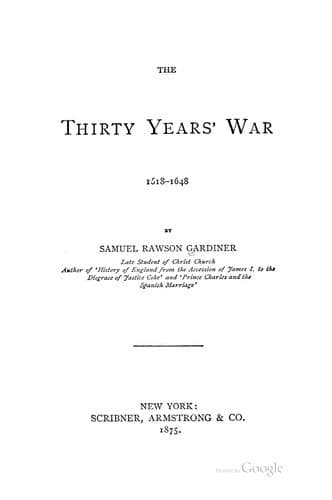
The Thirty Years' War, 1618-1648Gardiner, Samuel Rawson
History
The Thirty Years' War, 1618-1648
Gardiner, Samuel Rawson
Thirty Years' War, 1618-1648
Intolerance of Lewis XIV. and downfall of the
French monarchy 226
THE THIRTY YEARS' WAR.
CHAPTER I.
CAUSES OF THE THIRTY YEARS' WAR.
SECTION I.--_Political Institutions of Germany._
[Sidenote: § 1. Want of national institutions in Germany.]
It was the misfortune of Germany in the sixteenth and seventeenth
centuries that, with most of the conditions requisite for the formation
of national unity, she had no really national institutions. There was an
emperor, who looked something like an English king, and a Diet, or
General Assembly, which looked something like an English Parliament, but
the resemblance was far greater in appearance than in reality.
[Sidenote: § 2. The Emperor.]
The Emperor was chosen by three ecclesiastical electors, the Archbishops
of Mentz, Treves and Cologne, and four lay electors, the Elector
Palatine, the Electors of Saxony and Brandenburg, and the King of
Bohemia. In theory he was the successor of the Roman Emperors Julius and
Constantine, the ruler of the world, or of so much of it at least as he
could bring under his sway. More particularly, he was the successor of
Charles the Great and Otto the Great, the lay head of Western
Christendom. The Emperor Sigismund, on his death-bed, had directed that
his body should lie in state for some days, that men might see 'that the
lord of all the world was dead.' 'We have chosen your grace,' said the
electors to Frederick III., 'as head, protector, and governor of all
Christendom.' Yet it would be hard to find a single fragment of reality
corresponding to the magnificence of the claim.
[Sidenote: § 3. The German kingship.]
As far, however, as the period now under review is concerned, though the
name of Emperor was retained, it is unnecessary to trouble ourselves
with the rights, real or imaginary, connected with the imperial dignity.
Charles the Great, before the imperial crown was conferred on him, ruled
as king, by national assent or by conquest, over a great part of Western
Europe. When his dominions were divided amongst his successors, the rule
of those successors in Germany or elsewhere had no necessary connexion
with the imperial crown. Henry the Fowler, one of the greatest of the
Kings of the Germans, was never an emperor at all, and though, after the
reign of his son Otto the Great, the German kings claimed from the Pope
the imperial crown as their right, they never failed also to receive a
special German crown at Aachen (_Aix-la-Chapelle_) or at Frankfort as
the symbol of their headship over German lands and German men.
[Sidenote: § 4. Its connexion with the Empire.]
Public-domain text, read in full here on John Shaqi.
Reviews
Reviews
No reviews yet
Be the first to share your thoughts on this work.
Join the Discussion
Join the discussion
Sign in to leave a comment or review.
Sign InorCreate an account