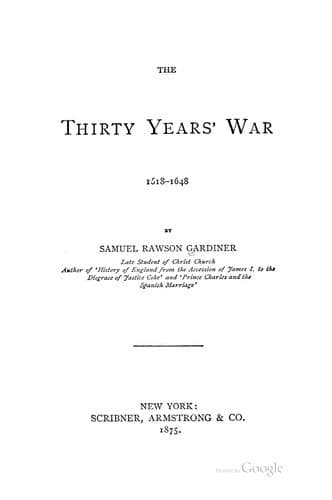
The Thirty Years' War, 1618-1648Gardiner, Samuel Rawson
History
The Thirty Years' War, 1618-1648
Gardiner, Samuel Rawson
Thirty Years' War, 1618-1648
The barriers set up against Protestantism were so plainly artificial
that they soon gave way. The princes claimed the right of continuing to
secularize Church lands within their territories as inseparable from
their general right of providing for the religion of their subjects. At
all events they had might on their side. About a hundred monasteries are
said to have fallen victims in the Palatinate alone, and an almost equal
number, the gleanings of a richer harvest which had been reaped before
the Convention of Passau, were taken possession of in Northern Germany.
[Sidenote: § 11. The Ecclesiastical Reservation.]
The Ecclesiastical Reservation applied to a different class of property,
namely, to the bishoprics and abbeys held immediately of the Empire.
Here, too, the Protestants found an excuse for evading the Treaty of
Augsburg. The object of the reservation, they argued, was not to keep
the bishoprics in Catholic hands, but to prevent quarrels arising
between the bishops and their chapters. If, therefore, a bishop elected
as a Catholic chose to turn Protestant, he must resign his see in order
to avoid giving offence to the Catholic chapter. But where a chapter,
itself already Protestant, elected a Protestant bishop, he might take
the see without hesitation, and hold it as long as he lived.
[Sidenote: § 12. The northern bishoprics Protestant.]
In this way eight of the great northern bishoprics soon came under
Protestant rule. Not that the Protestant occupant was in any real sense
of the word a bishop. He was simply an elected prince, calling himself a
bishop, or often more modestly an administrator, and looking after the
temporal affairs of his dominions.
[Sidenote: § 13. Good and bad side of the arrangement.]
In some respects the arrangement was a good one. The populations of
these territories were mainly Protestant, and they had no cause to
complain. Besides, if only a sufficient number of these bishoprics could
be gained to Protestantism, the factitious majority in the Diet might be
reversed, and an assembly obtained more truly representing the nation
than that which was in existence. But it must be acknowledged that the
whole thing had an ugly look; and it is no wonder that Catholics
pronounced these administrators to be no bishops at all, and to have no
right to hold the bishops' lands, or to take their seat as bishops in
the Diet of the Empire.
SECTION III.--_Reaction against Protestantism._
[Sidenote: § 1. Theological disputes among Protestants.]
Public-domain text, read in full here on John Shaqi.
Reviews
Reviews
No reviews yet
Be the first to share your thoughts on this work.
Join the Discussion
Join the discussion
Sign in to leave a comment or review.
Sign InorCreate an account