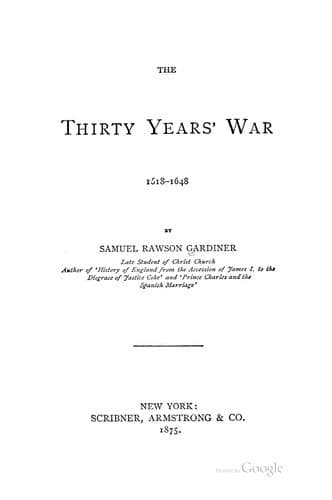
The Thirty Years' War, 1618-1648Gardiner, Samuel Rawson
History
The Thirty Years' War, 1618-1648
Gardiner, Samuel Rawson
Thirty Years' War, 1618-1648
In course of time Protestantism, in its turn, exposed itself to attack.
Each petty court soon had its own school of theologians, whose minds
were dwarfed to the limits of the circle which they influenced with
their logic and their eloquence. The healthful feeling which springs
from action on a large stage was wanting to them. Bitterly wrangling
with one another, they were eager to call in the secular arm against
their opponents. Seizing the opportunity, the newly-constituted order of
Jesuits stepped forward to bid silence in the name of the renovated
Papal Church, alone, as they urged, able to give peace instead of
strife, certainty instead of disputation. The Protestants were taken at
a disadvantage. The enthusiasm of a national life, which repelled the
Jesuits in the England of the sixteenth century, and the enthusiasm of
scientific knowledge which repels them in the Germany of the nineteenth
century, were alike wanting to a Germany in which national life was a
dream of the past, and science a dream of the future. Luther had long
ago passed away from the world. Melanchthon's last days were spent in
hopeless protest against the evil around him. 'For two reasons,' he
said, as he lay upon his death-bed, 'I desire to leave this life: First,
that I may enjoy the sight, which I long for, of the Son of God and of
the Church in Heaven. Next, that I may be set free from the monstrous
and implacable hatreds of the theologians.'
[Sidenote: § 2. The Catholics make progress.]
In the face of a divided people, or self-seeking princes, and of
conflicting theories, the Jesuits made their way. Step by step the
Catholic reaction gained ground, not without compulsion, but also not
without that moral force which makes compulsion possible. The bishops
and abbots gave their subjects the choice between conversion and exile.
An attempt made by the Archbishop of Cologne to marry and turn
Protestant was too plainly in contradiction to the Ecclesiastical
Reservation to prosper, and when the Protestant majority of the Chapter
of Strasburg elected a Protestant bishop they were soon overpowered. A
Protestant Archbishop of Magdeburg offering to take his place amongst
the princes of the Empire at the Diet was refused admission, and though
nothing was done to dispossess him and the other northern administrators
of their sees, yet a slur had been cast upon their title which they were
anxious to efface. A few years later a legal decision was obtained in
the cases of four monasteries secularized after the Convention of
Passau, and that decision was adverse to the claim of the Protestants.
[Sidenote: § 3. The disputes which led finally to war.]
Public-domain text, read in full here on John Shaqi.
Reviews
Reviews
No reviews yet
Be the first to share your thoughts on this work.
Join the Discussion
Join the discussion
Sign in to leave a comment or review.
Sign InorCreate an account