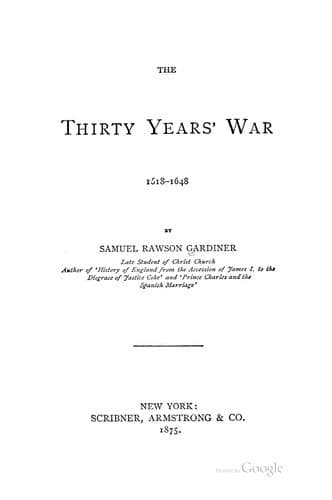
The Thirty Years' War, 1618-1648Gardiner, Samuel Rawson
History
The Thirty Years' War, 1618-1648
Gardiner, Samuel Rawson
Thirty Years' War, 1618-1648
The third party, the German Lutherans, looked with equal abhorrence upon
aggression on either side. Their leader, John George, Elector of Saxony,
stood aloof alike from Christian of Anhalt, and from Maximilian of
Bavaria. He was attached by the traditions of his house as well as by
his own character to the Empire and the House of Austria. But he was
anxious to obtain security for his brother Protestants. He saw there
must be a change; but he wisely desired to make the change as slight as
possible. In 1612, therefore, he proposed that the highest jurisdiction
should still be retained by the Imperial Council, but that the Council,
though still nominated by the Emperor, should contain an equal number of
Catholics and Protestants. Sentences such as that which had deprived
Donauwörth of its civil rights would be in future impossible.
[Sidenote: § 19. His weakness of character.]
Unhappily, John George had not the gift of ruling men. He was a hard
drinker and a bold huntsman, but to convert his wishes into actual facts
was beyond his power. When he saw his plan threatened with opposition on
either side he left it to take care of itself. In 1613 a Diet met, and
broke up in confusion, leaving matters in such a state that any spark
might give rise to a general conflagration.
CHAPTER II.
THE BOHEMIAN REVOLUTION.
SECTION I.--_The House of Austria and its Subjects._
[Sidenote: § 1. The Austrian dominions.]
At the beginning of the seventeenth century the dominions of the German
branch of the House of Austria were parcelled out amongst the various
descendants of Ferdinand I., the brother of Charles V. The head of the
family, the Emperor Rudolph II., was Archduke of Austria--a name which
in those days was used simply to indicate the archduchy itself, and not
the group of territories which are at present ruled over by the Austrian
sovereign--and he was also King of Bohemia and of Hungary. His brother
Maximilian governed Tyrol, and his cousin Ferdinand ruled in Styria,
Carinthia, and Carniola.
[Sidenote: § 2. Aristocracy and Protestantism.]
The main difficulty of government arose from the fact that whilst every
member of the family clung firmly to the old creed, the greater part of
the population, excepting in Tyrol, had adopted the new; that is to say,
that on the great question of the day the subjects and the rulers had no
thoughts in common. And this difficulty was aggravated by the further
fact that Protestantism prospered mainly from the support given to it by
a powerful aristocracy, so that political disagreement was added to the
difference in religion. Ferdinand had, indeed, contrived to put down
with a strong hand the exercise of Protestantism in his own dominions so
easily as almost to suggest the inference that it had not taken very
deep root in those Alpine regions. But Rudolph was quite incapable of
following his example. If not absolutely insane, he was subject to
sudden outbursts of temper, proceeding from mental disease.
Public-domain text, read in full here on John Shaqi.
Reviews
Reviews
No reviews yet
Be the first to share your thoughts on this work.
Join the Discussion
Join the discussion
Sign in to leave a comment or review.
Sign InorCreate an account