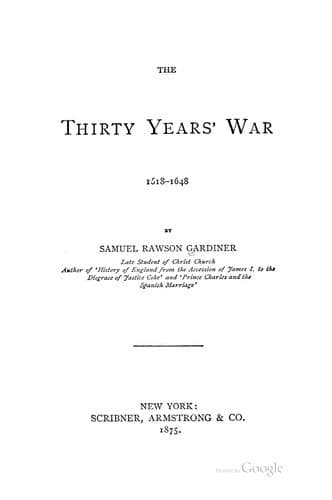
The Thirty Years' War, 1618-1648Gardiner, Samuel Rawson
History
The Thirty Years' War, 1618-1648
Gardiner, Samuel Rawson
Thirty Years' War, 1618-1648
There are moments when the character of a nation or party stands
revealed as by a lightning flash, and this was one of them. It is not in
such a way as this that successful revolutions are begun.
[Sidenote: § 6. The revolutionary government.]
The first steps to constitute a new government were easy. Thirty
Directors were appointed, and the Jesuits were expelled from Bohemia.
The Diet met and ordered soldiers to be levied to form an army. But to
support this army money would be needed, and the existing taxes were
insufficient. A loan was accordingly thought of, and the nobles resolved
to request the towns to make up the sum, they themselves contributing
nothing. The project falling dead upon the resistance of the towns, new
taxes were voted; but no steps were taken to collect them, and the army
was left to depend in a great measure upon chance.
[Sidenote: § 7. The Elector of Saxony wishes for peace.]
Would the princes of Germany come to the help of the Directors? John
George of Saxony told them that he deeply sympathized with them, but
that rebellion was a serious matter. To one who asked him what he meant
to do, he replied, 'Help to put out the fire.'
[Sidenote: § 8. The Elector Palatine holds out hopes of assistance.]
There was more help for them at Heidelberg than at Dresden. Frederick
IV. had died in 1610, and his son, the young Frederick V., looked up to
Christian of Anhalt as the first statesman of his age. By his marriage
with Elizabeth, the daughter of James I. of England, he had contracted
an alliance which gave him the appearance rather than the reality of
strength. He offered every encouragement to the Bohemians, but for the
time held back from giving them actual assistance.
SECTION III.--_The War in Bohemia._
[Sidenote: § 1. Outbreak of war.]
The Directors were thus thrown on their own resources. Ferdinand had
secured his election as king of Hungary, and, returning to Vienna, had
taken up the reins of government in the name of Matthias. He had got
together an army of 14,000 men, under the command of Bucquoi, an officer
from the great school of military art in the Netherlands, and on August
13, the Bohemian frontier was invaded. War could hardly be avoided by
either side. Budweis and Pilsen, two Catholic towns in Bohemia,
naturally clung to their sovereign, and as soon as the Directors ordered
an attack upon Budweis, the troops of Matthias prepared to advance to
its succour.
[Sidenote: § 2. The Bohemians vote men, but object to paying taxes.]
The Directors took alarm, and proposed to the Diet that new taxes should
be raised and not merely voted, and that, in addition to the army of
regular soldiers, there should be a general levy of a large portion of
the population. To the levy the Diet consented without difficulty. But
before the day fixed for discussing the proposed taxes arrived, the
majority of the members deliberately returned to their homes, and no new
taxes were to be had.
Public-domain text, read in full here on John Shaqi.
Reviews
Reviews
No reviews yet
Be the first to share your thoughts on this work.
Join the Discussion
Join the discussion
Sign in to leave a comment or review.
Sign InorCreate an account