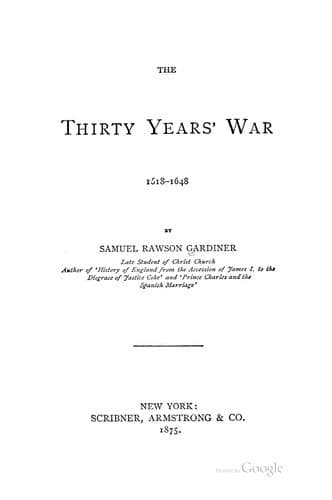
The Thirty Years' War, 1618-1648Gardiner, Samuel Rawson
History
The Thirty Years' War, 1618-1648
Gardiner, Samuel Rawson
Thirty Years' War, 1618-1648
[Sidenote: § 3. They are not likely to prosper.]
This day, August 30, may fairly be taken as the date of the political
suicide of the Bohemian aristocracy. In almost every country in Europe
order was maintained by concentrating the chief powers of the State in
the hands of a single governor, whether he were called king, duke, or
elector. To this rule there were exceptions in Venice, Switzerland, and
the Netherlands, and by-and-by there would be an exception on a grander
scale in England. But the peoples who formed these exceptions had
proved themselves worthy of the distinction, and there would be no room
in the world for men who had got rid of their king without being able to
establish order upon another basis.
[Sidenote: § 4. Help from Savoy.]
Still there were too many governments in Europe hostile to the House of
Austria to allow the Bohemians to fall at once. Charles Emmanuel, Duke
of Savoy, had just brought a war with Spain to a close, but he had not
become any better disposed towards his late adversary. He accordingly
entered into an agreement with the leaders of the Union, by which 2,000
men who had been raised for his service were to be placed at the
disposal of the Bohemian Directors.
[Sidenote: § 5. Mansfeld.]
The commander of these troops was Count Ernest of Mansfeld, an
illegitimate son of a famous general in the service of Spain. He had
changed his religion and deserted his king. He now put himself forward
as a champion of Protestantism. He was brave, active, and versatile, and
was possessed of those gifts which win the confidence of professional
soldiers. But he was already notorious for the readiness with which he
allowed his soldiers to support themselves on the most unbridled
pillage. An adventurer himself, he was just the man to lead an army of
adventurers.
[Sidenote: § 6. A forced loan.]
Soon after his arrival in Bohemia, Mansfeld was employed in the siege of
Pilsen, whilst Thurn was occupied with holding Bucquoi in check. The
failure in obtaining additional taxes had led the Directors to adopt the
simple expedient of levying a forced loan from the few rich.
[Sidenote: § 7. Success of the Bohemians.]
For a time this desperate expedient was successful. The help offered to
Ferdinand by Spain was not great, and it was long in coming. The prudent
Maximilian refused to ruin himself by engaging in an apparently
hopeless cause. At last the Silesians, who had hesitated long, threw in
their lot with their neighbours, and sent their troops to their help
early in November. Bucquoi was in full retreat to Budweis. On the 21st
Pilsen surrendered to Mansfeld. Further warfare was stopped as winter
came on--a terrible winter for the unhappy dwellers in Southern Bohemia.
Starving armies are not particular in their methods of supplying their
wants. Plunder, devastation and reckless atrocities of every kind fell
to the lot of the doomed peasants, Bucquoi's Hungarians being
conspicuous for barbarity.
Public-domain text, read in full here on John Shaqi.
Reviews
Reviews
No reviews yet
Be the first to share your thoughts on this work.
Join the Discussion
Join the discussion
Sign in to leave a comment or review.
Sign InorCreate an account