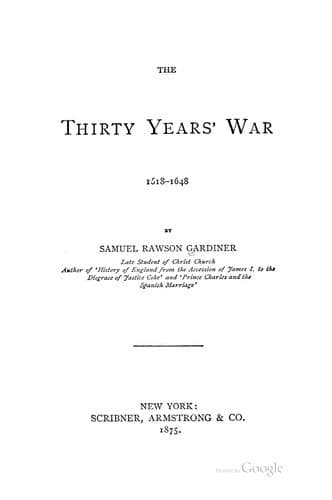
The Thirty Years' War, 1618-1648Gardiner, Samuel Rawson
History
The Thirty Years' War, 1618-1648
Gardiner, Samuel Rawson
Thirty Years' War, 1618-1648
The winter was coming on, and there would be time for negotiations
before another blow was struck. But to give negotiations a chance it was
necessary that Mansfeld's army should be fed, in order that he might be
able to keep quiet while the diplomatists were disputing. James,
therefore, wisely proposed to provide a sum of money for this purpose.
But a quarrel with the House of Commons hurried on a dissolution, and he
was unable to raise money sufficient for the purpose without a grant
from Parliament.
[Sidenote: § 2. England and Spain.]
James, poor and helpless, was thus compelled to fall back upon the
friendship of Spain, a friendship which he hoped to knit more closely by
a marriage between his son, the Prince of Wales, and a Spanish Infanta.
The Spanish Government was anxious, if possible, to avoid an extension
of the war in Germany. Though all the riches of the Indies were at its
disposal, that government was miserably poor. In a land where industry,
the source of wealth, was held in dishonour, all the gold in the world
was thrown away. Scarcely able to pay the armies she maintained in time
of peace, Spain had now again to find money for the war in the
Netherlands. In 1621 the twelve years' truce with the Dutch had come to
an end, and Spinola's armies in Brabant and Flanders could not live,
like Mansfeld's at the expense of the country, for fear of throwing the
whole of the obedient provinces, as they were called, into the enemies'
hands. If possible, therefore, that yawning gulf of the German war,
which threatened to swallow up so many millions of ducats, must be
closed. And yet how was it to be done? The great difficulty in the way
of peace did not lie in Frederick's pretensions. They could easily be
swept aside. The great difficulty lay in this--that the Catholics,
having already the institutions of the Empire in their hands, were now
also in possession of a successful army. How, under such circumstances,
was Protestantism, with which so many temporal interests were bound up,
to feel itself secure? And without giving security to Protestantism, how
could a permanent peace be obtained?
[Sidenote: § 3. Spanish plans.]
Public-domain text, read in full here on John Shaqi.
Reviews
Reviews
No reviews yet
Be the first to share your thoughts on this work.
Join the Discussion
Join the discussion
Sign in to leave a comment or review.
Sign InorCreate an account