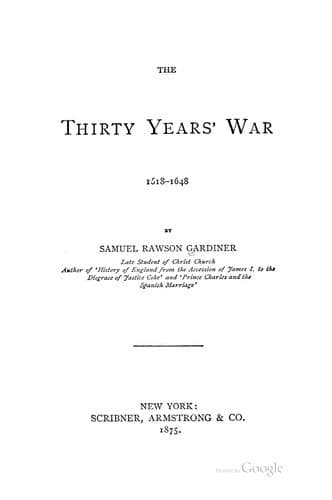
The Thirty Years' War, 1618-1648Gardiner, Samuel Rawson
History
The Thirty Years' War, 1618-1648
Gardiner, Samuel Rawson
Thirty Years' War, 1618-1648
But Germany was not an island. Around it lay a multitude of powers with
conflicting interests, but all finding in her distractions a fair field
for pursuing their own objects. Ferdinand, in fact, had made himself
just strong enough to raise the jealousy of his neighbours, but not
strong enough to impose an impassible barrier to their attacks. He had
got on his side the legal and military elements of success. He had put
down all resistance. He had frightened those who dreaded anarchy. But he
had not touched the national heart. He had taught men to make it a mere
matter of calculation whether a foreign invasion was likely to do them
more damage than the success of their own Emperor. Whilst he affected to
speak in the name of Germany, more than half of Germany was neutral if
not adverse in the struggle.
[Sidenote: 1623.
§ 3. Breach between England and Spain.]
England, at last, was giving signs of warlike preparation. Prince
Charles had paid a visit to Madrid in hopes of bringing home a Spanish
bride, and of regaining the Palatinate for his brother-in-law. He had
come back without a wife, and with the prospect of getting back the
Palatinate as distant as ever. He had learned what the Spanish plan was,
that wonderful scheme for educating Frederick's children at Vienna, with
all ostensible guarantees for keeping them in their father's faith,
which were, however, almost certain to come to nothing when reduced to
practice. And so he came back angry with the Spaniards, and resolved to
urge his father to take up arms. In the spring of 1624 all negotiations
between England and Spain were brought to an end, and Parliament was
discussing with the king the best means of recovering the Palatinate.
[Sidenote: § 4. English plans.]
In the English House of Commons there was but little real knowledge of
German affairs. The progress of the Emperor and the League was of too
recent a date to be thoroughly comprehended. Men, remembering the days
of Philip II., were inclined to overestimate the power of Spain, and to
underestimate the power of the Emperor. They therefore fancied that it
would be enough to attack Spain by sea, and to send a few thousand
soldiers to the aid of the Dutch Republic.
[Sidenote: § 5. Question between the king and the House of Commons.]
James, if he was not prompt in action, at all events knew better than
this. He believed that the Imperial power was now too firmly rooted in
Germany to fall before anything short of a great European confederacy.
From this the Commons shrunk. A war upon the continent would be
extremely expensive, and, after all, their wrath had been directed
against Spain, which had meddled with their internal affairs, rather
than against the Emperor, who had never taken the slightest interest in
English politics. The utmost they would do was to accept the king's
statement that he would enter into negotiations with other powers and
would lay the results before them in the winter.
Public-domain text, read in full here on John Shaqi.
Reviews
Reviews
No reviews yet
Be the first to share your thoughts on this work.
Join the Discussion
Join the discussion
Sign in to leave a comment or review.
Sign InorCreate an account