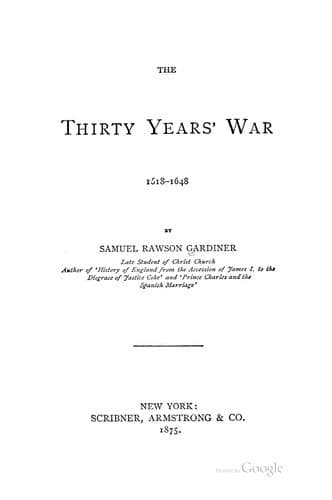
The Thirty Years' War, 1618-1648Gardiner, Samuel Rawson
History
The Thirty Years' War, 1618-1648
Gardiner, Samuel Rawson
Thirty Years' War, 1618-1648
If Richelieu intended seriously to take part in the German war, this was
cause enough for hesitation. Cleverly availing himself of the
expectations formed of the French alliance in England and Holland, he
contrived to borrow ships from both those countries, and before the
autumn was over Soubise was driven to take refuge in England. But
Rochelle and the Huguenots on land were still unconquered, and Ferdinand
was safe for the moment from any considerable participation of France in
the German war. Whether Richelieu would at any time be able to take up
again the thread of his plans depended in the first place upon his
success in suppressing rebellion, but quite as much upon the use which
he might make of victory if the event proved favourable to him. A
tolerant France might make war with some chances in its favour. A France
composed of conquerors and conquered, in which each party regarded the
other as evil-doers to be suppressed, not as erring brothers to be
argued with, would weigh lightly enough in the scale of European
politics.
CHAPTER V.
INTERVENTION OF THE KING OF DENMARK.
SECTION I.--_Christian IV. and Gustavus Adolphus._
[Sidenote: § 1. Denmark and Sweden.]
Whilst France was thus temporarily hindered from taking part in German
affairs, and whilst James and his son were promising more than their
poverty would allow them to perform, the rulers of Denmark and Sweden
were watching with increasing interest the tide of war as it rolled
northwards.
[Sidenote: § 2. Christian IV.]
Christian IV. of Denmark had every reason to look with anxiety upon the
future. As Duke of Holstein, he was a member of the Lower Saxon circle,
and he had long been doing his best to extend his influence over the
coasts of the North Sea. By his new fortifications at Glückstadt he
aimed at intercepting the commerce of Hamburg, and his success in
procuring for one of his sons the Bishopric of Verden and the
coadjutorship and eventual succession to the archbishopric of Bremen was
doubtless specially grateful to him on account of the position he thus
acquired on the Elbe and the Weser. The question of the Protestant
bishoprics was therefore a very important question to him personally,
and he was well aware that a real national empire in Germany would make
short work with his attempts to establish his dominion over the mouths
of the German rivers.
[Sidenote: § 3. His early interest in the war.]
Public-domain text, read in full here on John Shaqi.
Reviews
Reviews
No reviews yet
Be the first to share your thoughts on this work.
Join the Discussion
Join the discussion
Sign in to leave a comment or review.
Sign InorCreate an account