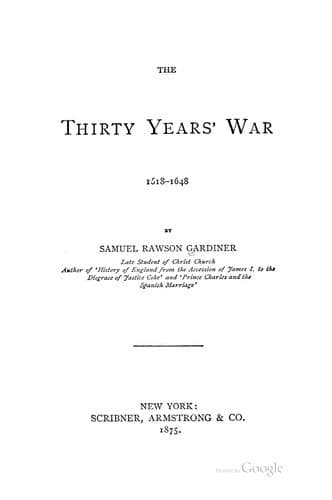
The Thirty Years' War, 1618-1648Gardiner, Samuel Rawson
History
The Thirty Years' War, 1618-1648
Gardiner, Samuel Rawson
Thirty Years' War, 1618-1648
His attention was not now called for the first time to the progress of
the war. Like all the Lutheran princes, he had thoroughly disapproved of
Frederick's Bohemian enterprise. But when Frederick was a fugitive he
had seen that a strong force was needed to stop the Emperor from a
retaliation which would be ruinous to the Protestants, and he had in the
beginning of 1621 given a willing ear to James's proposal for a joint
armament in defence of the Palatinate. Had the war been undertaken then,
with the character of moderation which James and Christian would have
been certain to impress upon it, the world might perhaps have been
spared the spectacle of Mansfeld's plunderings, with their unhappy
results. But James came too soon to the conclusion that it was
unnecessary to arm till mediation had failed; and Christian, auguring no
good from such a course, drew back and left the Palatinate to its fate.
But the events which followed had increased his anxiety, and in 1624 his
mind was distracted between his desire to check the growth of the
imperial power and his hesitation to act with allies so vacillating and
helpless as the Lower Saxon princes were proving themselves to be. In
his own lands he had shown himself a good administrator and able ruler.
Whether he was possessed of sufficient military capacity to cope with
Tilly remained to be seen.
[Sidenote: § 4. Gustavus Adolphus.]
Gustavus Adolphus, King of Sweden, was a man of a higher stamp. His is
the one of the few names which relieve the continental Protestantism of
the seventeenth century from the charge of barrenness. Possessed of a
high and brilliant imagination, and of a temperament restless and
indefatigable, to which inaction was the sorest of trials, he was never
happier than when he was infusing his own glowing spirit into the
comrades of some perilous enterprise. Christian of Brunswick was not
more ready than he to lead a charge or to conduct a storm. But he had,
too, that of which no thought ever entered the mind of Christian for an
instant--the power of seeing facts in their infinite variety as they
really were, and the self-restraint with which he curbed in his
struggling spirit and his passionate longing for action whenever a calm
survey of the conditions around showed him that action was inexpedient.
In all the pages of history there is probably no man who leaves such an
impression of that energy under restraint, which is the truest mark of
greatness in human character as it is the source of all that is sublime
or lovely in nature or in art.
[Sidenote: § 5. His conflict with Poland and Russia.]
Public-domain text, read in full here on John Shaqi.
Reviews
Reviews
No reviews yet
Be the first to share your thoughts on this work.
Join the Discussion
Join the discussion
Sign in to leave a comment or review.
Sign InorCreate an account