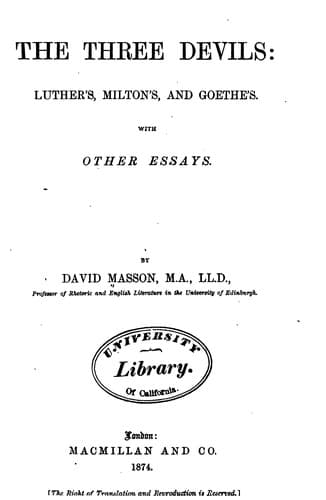
The Three Devils: Luther's, Milton's, and Goethe's; With Other EssaysMasson, David
History
The Three Devils: Luther's, Milton's, and Goethe's; With Other Essays
Masson, David
Devil in literature; Literature -- History and criticism
and then running to the footlights and beginning her speech to the
audience:--
"I come, kind gentlemen, strange news to tell ye:
I am the ghost of poor departed Nelly.
Sweet ladies, be not frighted; I'll be civil:
I'm what I was, a little harmless devil." &c. &c.
It is a tradition that it was this epilogue that effected Nell's conquest
of the king, and that he was so fascinated with her manner of delivering
it, that he went behind the scenes after the play was over and carried her
off. Ah! and it is two hundred years since that fascinating run to the
footlights took place, and the swarthy face of the monarch was seen
laughing, and the audience shrieked and clapped with delight, and Pepys
bustled about the boxes, and Dryden sat looking placidly on, contented
with his success, and wondering how much of it was owing to Nelly!
One can see how, even if the choice had been made strictly with a
reference to the claims of the candidates, it would have been felt that
Dryden, and not Butler, was the proper man to succeed Davenant in the
laureateship. If Butler had shewn the more original vein of talent in one
peculiar walk, Dryden had proved himself the man of greatest general
strength, in whom were more broadly represented the various literary
tendencies of his time. The author of ten plays, four of which were
stately rhymed tragedies, and the rest comedies in prose and blank verse;
the author, also, of various occasional poems, one of which, the _Annus
Mirabilis_, was noticeable on its own account as the best poem of current
history; the author, moreover, of one express prose-treatise, and of
various shorter prose dissertations in the shape of prefaces and the like
prefixed to his separate plays and poems, in which the principles of
literature were discussed in a manner at once masterly and adapted to the
prevailing taste: Dryden was, on the whole, far more likely to perform
well that part of a laureate's duties which consisted in supervising and
leading the general literature of his age than a man whose reputation,
though justly great, had been acquired by one continuous effort in the
single department of burlesque. Accordingly, Dryden was promoted to the
post, and Butler was left to finish, on his own scanty resources, the
remaining portion of his _Hudibras_, varying the occupation by jotting
down those scraps of cynical thought which were found among his posthumous
papers, and which show that towards the end of his days there were other
things that he hated and would have lashed besides Puritanism. Thus:--
"'Tis a strange age we've lived in and a lewd
As e'er the sun in all his travels viewed."
Again:
"The greatest saints and sinners have been made
Of proselytes of one another's trade."
Again:
"Authority is a disease and cure
Which men can neither want nor well endure."
And again, with an obvious reference to his own case:--
Public-domain text, read in full here on John Shaqi.
Reviews
Reviews
No reviews yet
Be the first to share your thoughts on this work.
Elsewhere in the archive
Join the Discussion
Join the discussion
Sign in to leave a comment or review.
Sign InorCreate an account