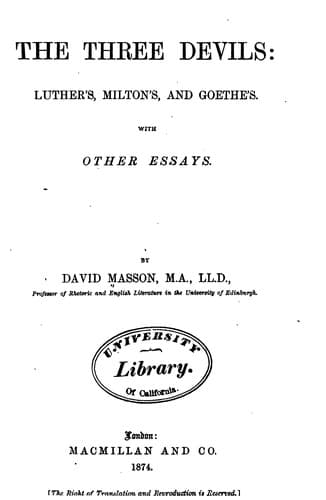
The Three Devils: Luther's, Milton's, and Goethe's; With Other EssaysMasson, David
History
The Three Devils: Luther's, Milton's, and Goethe's; With Other Essays
Masson, David
Devil in literature; Literature -- History and criticism
rights against pretenders, he made a terrible example of one poor wretch,
who had been puffed for the moment into undue popularity. This unfortunate
was Elkanah Settle, and the occasion of the attack was a heroic tragedy
written by Settle, acted with great success both on the stage and at
Whitehall, and published with illustrative woodcuts. On this performance
Dryden made a most merciless onslaught in a prose-criticism prefixed to
his next published play, tearing Settle's metaphors and grammar to pieces.
Settle replied with some spirit, but little effect, and was, in fact,
"settled" for ever. Rochester next patronized Crowne and Otway for a time,
but soon gave them up, and contented himself with assailing Dryden more
directly in such lampoons as we have quoted. In the year 1679, however,
suspecting Dryden to have had a share in the authorship of a poem, then
circulating in manuscript, in which certain liberties were taken with his
name, he caused him to be way-laid and beaten as he was going home one
evening through Rose-alley to his house in Gerard-street. The poem,
entitled _An Essay on Satire_, is usually printed among Dryden's works;
but it remains uncertain whether Dryden was really the author.
It was fortunate for Dryden and for English literature that, just about
this time, when he was beginning to be regarded as a veteran among the
dramatists, whose farther services in that department the town could
afford to spare, circumstances led him, almost without any wish of his
own, into a new path of literature. He was now arrived at the ripe age of
fifty years, and, if an inventory had been made of his writings, they
would have been found to consist of twenty-one dramas, with a series of
critical prose-essays for the most part bound up with these dramas, but
nothing in the nature of non-dramatic poetry, except a few occasional
pieces, of which the _Annus Mirabilis_ was still the chief. Had a
discerning critic examined those works with a view to discover in what
peculiar vein of verse Dryden, if he abandoned the drama, might still do
justice to his powers, he would certainly have selected the vein of
reflective satire. Of the most nervous and emphatic lines that could have
been quoted from his plays a large proportion would have been found to
consist of what may be called _maxim_ metrically expressed; while in his
dramatic prologues and epilogues, which were always thought among the
happiest efforts of his pen, the excellence would have been found to
consist in very much the same power of direct didactic declamation applied
satirically to the humours, manners, and opinions of the day. Whether any
critic, observing all this, would have been bold enough to advise Dryden
to take the hint, and quit the drama for satirical, controversial, and
didactic poetry, we need not inquire. Circumstances compelled what advice
might have failed to bring about. After some twenty years of political
Public-domain text, read in full here on John Shaqi.
Reviews
Reviews
No reviews yet
Be the first to share your thoughts on this work.
Elsewhere in the archive
Join the Discussion
Join the discussion
Sign in to leave a comment or review.
Sign InorCreate an account