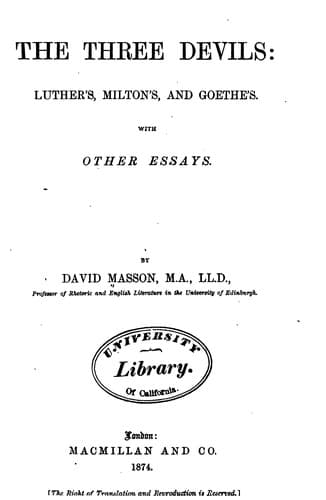
The Three Devils: Luther's, Milton's, and Goethe's; With Other EssaysMasson, David
History
The Three Devils: Luther's, Milton's, and Goethe's; With Other Essays
Masson, David
Devil in literature; Literature -- History and criticism
stagnation, or rather of political confusion, relieved only by the
occasional cabals of leading statesmen, and by rumours of Catholic and
Protestant plots, the old Puritan feeling and the general spirit of civil
liberty which the Restoration had but pent up within the vitals of England
broke forth in a regular and organized form as modern English Whiggism.
The controversy had many ramifications; but its immediate phase at that
moment was an antagonism of two parties on the question of the succession
to the crown after Charles should die--the Tories and Catholics
maintaining the rights of the Duke of York as the legal heir, and the
Whigs and Protestants rallying, for want of a better man, round Charles's
illegitimate son, the handsome and popular Duke of Monmouth, then a puppet
in the hands of Shaftesbury, the recognised leader of the Opposition.
Charles himself was forced by reasons of state to take part with his
brother, and to frown on Monmouth; but this did not prevent the lords and
wits of the time from distributing themselves pretty equally between the
two parties, and fighting out the dispute with all the weapons of intrigue
and ridicule. Shadwell, Settle, and some other minor poets, lent their
pens to the Whigs, and wrote squibs and satires in the Whig service. Lee,
Otway, Tate, and others, worked for the Court party. Dryden, as laureate
and Tory, had but one course to take. He plunged into the controversy with
the whole force of his genius; and in November, 1681, when the nation was
waiting for the trial of Shaftesbury, then a prisoner in the Tower, he
published his satire of _Absalom and Achitophel_, in which, under the thin
veil of a story of Absalom's rebellion against his father David, the
existing political state of England was represented from the Tory point of
view. Among the characters portrayed in it Dryden had the satisfaction of
introducing his old critic, the Duke of Buckingham, upon whom he now took
ample revenge.
Public-domain text, read in full here on John Shaqi.
Reviews
Reviews
No reviews yet
Be the first to share your thoughts on this work.
Elsewhere in the archive
Join the Discussion
Join the discussion
Sign in to leave a comment or review.
Sign InorCreate an account