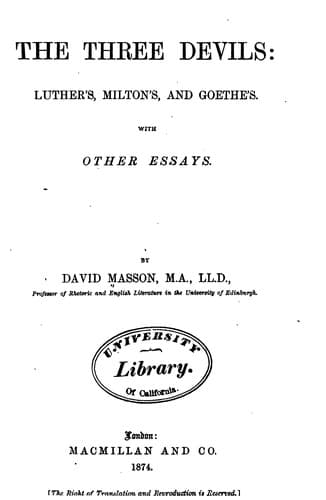
The Three Devils: Luther's, Milton's, and Goethe's; With Other EssaysMasson, David
History
The Three Devils: Luther's, Milton's, and Goethe's; With Other Essays
Masson, David
Devil in literature; Literature -- History and criticism
Among all the vast angelic population three or four individuals stood
pre-eminent and unapproachable. These were the Archangels. Satan was one
of these: if not the highest Archangel in Heaven, he was one of the four
highest. After God, he could feel conscious of being the greatest being in
the Universe. But, although the relation between the Deity and the
angelic population was so close that we can only express it by having
recourse to the conception of physical nearness, yet even to the Angels
the Deity was so shrouded in clouds and mystery that the highest Archangel
might proceed on a wrong notion of his character, and, just as human
beings do, might believe the Divine omnipotence as a theological
proposition, and yet, in going about his enterprises, might not carry a
working consciousness of it along with him. There is something in the
exercise of power, in the mere feeling of existence, in the stretching out
of a limb, in the resisting of an obstacle, in being active in any way,
which generates a conviction that our powers are self-contained, hostile
to the recollection of inferiority or accountability. A messenger,
employed in his master's business, becomes, in the very act of serving
him, forgetful of him. As the feeling of enjoyment in action grows strong,
the feeling of a dependent state of being, the feeling of being a
messenger, grows weak. Repose and physical weakness are favourable to the
recognition of a derived existence: hence the beauty of the feebleness of
old age preceding the approach of death. The feebleness of the body
weakens the self-sufficient feeling, and disposes to piety. The young man,
rejoicing in his strength, cannot believe that his breath is in his
nostrils. In some such way the Archangel fell. Rejoicing in his strength,
walking colossal through Heaven, gigantic in his conceptions, incessant in
his working, ever scheming, ever imagining new enterprises, Satan was in
his very nature the most active of God's Archangels. He was ever doing
some great thing, and ever thirsting for some greater thing to do. And,
alas! his very wisdom became his folly. His notion of the Deity was higher
and grander than that of any other Angel: but, then, he was not a
contemplative spirit; and his feeling of derived existence grew weak in
the glow and excitement of constant occupation. As the feeling of
enjoyment in action grew strong, the feeling of being an Angel grew weak.
Thus the mere duration of his existence had undermined his strength and
prepared him for sin. Although the greatest Angel in Heaven--nay, just
because he was such--he was the readiest to fall.
Public-domain text, read in full here on John Shaqi.
Reviews
Reviews
No reviews yet
Be the first to share your thoughts on this work.
Join the Discussion
Join the discussion
Sign in to leave a comment or review.
Sign InorCreate an account