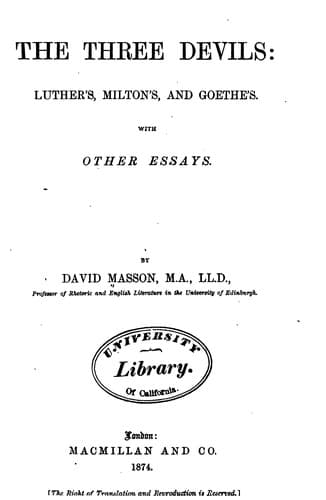
The Three Devils: Luther's, Milton's, and Goethe's; With Other EssaysMasson, David
History
The Three Devils: Luther's, Milton's, and Goethe's; With Other Essays
Masson, David
Devil in literature; Literature -- History and criticism
At last an occasion came. When the intimation was made by the Almighty in
the Congregation of the Angels that he had anointed his only-begotten Son
King on the holy hill of Zion, the Archangel frowned and became a rebel:
not because he had weighed the enterprise to which he was committing
himself, but because he was hurried on by the impetus of an over-wrought
nature. Even had he weighed the enterprise, and found it wanting, he would
have been a rebel nevertheless; he would have rushed into ruin on the
wheels of his old impulses. He could not have said to himself "It is
useless to rebel, and I will not;" and, if he could, what a hypocrite to
have remained in Heaven! His revolt was the natural issue of the thoughts
to which he had accustomed himself; and his crime lay in having acquired a
rebellious constitution, in having pursued action too much, and spurned
worship and contemplation. Herein lay the difference between him and the
other Archangels, Raphael, Gabriel, and Michael.
Satan in his revolt carried a third part of the Angels with him. He had
accustomed many of the Angels to his mode of thinking. One of the ways in
which he gratified his desire for activity had been that of exerting a
moral and intellectual influence over the inferior Angels. A few of these
he had liked to associate with, discoursing with them, and observing how
they imbibed his ideas. His chief associate, almost his bosom-companion,
had been Beelzebub, a princely Angel. Moloch, Belial, and Mammon, had
likewise been admitted to his confidence. These five had constituted a
kind of clique in Heaven, giving the word to a whole multitude of inferior
Angels, all of them resembling their leader in being fonder of action than
of contemplation. Thus, in addition to the mere hankering after action,
there had grown up in Satan's mind a love of power. This feeling that it
was a glorious thing to be a leader seems to have had much to do with his
voluntary sacrifice of happiness. We may conceive it to have been
voluntary. Foreseeing never so much misery would not have prevented such a
spirit from rebelling. Having a third of the Angels away with him in some
dark, howling region, where he might rule over them alone, would have
seemed, even if he had foreseen it, infinitely preferable to the puny
sovereignty of an Archangel in that world of gold and emerald: "better to
reign in Hell than serve in Heaven." Thus we conceive him to have faced
the anticipation of the future. It required little persuasion to gain over
the kindred spirit of Beelzebub. These two appear to have conceived the
enterprise from the beginning in a different light from that in which they
represented it to their followers. Happiness with the inferior Spirits was
a more important consideration than with such Spirits as Satan and
Beelzebub; and to have hinted the possibility of losing happiness in the
enterprise would have been to terrify them away. Satan and Beelzebub were
Public-domain text, read in full here on John Shaqi.
Reviews
Reviews
No reviews yet
Be the first to share your thoughts on this work.
Join the Discussion
Join the discussion
Sign in to leave a comment or review.
Sign InorCreate an account