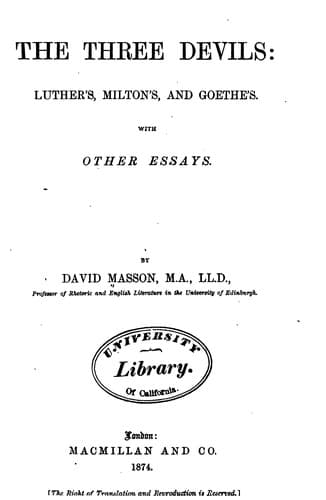
The Three Devils: Luther's, Milton's, and Goethe's; With Other EssaysMasson, David
History
The Three Devils: Luther's, Milton's, and Goethe's; With Other Essays
Masson, David
Devil in literature; Literature -- History and criticism
The satire of _Absalom and Achitophel_, than which nothing finer of the
kind had ever appeared in England, and which indeed surpassed all that
could have been expected even from Dryden at that time, was the first of a
series of polemical or satirical poems the composition of which occupied
the last eight years of his laureateship. _The Medal, a Satire against
Sedition_, appeared in March, 1682, as the poet's comment on the popular
enthusiasm occasioned by the acquittal of Shaftesbury; _Mac Flecknoe_, in
which Shadwell, as poet-in-chief of the Whigs, received a thrashing all to
himself, was published in October in the same year; and, a month later,
there appeared the so-called _Second Part of Absalom and Achitophel_,
written by Nahum Tate, under Dryden's superintendence, and with
interpolations from Dryden's pen. In the same avowed character, as
literary champion of the government and the party of the Duke of York,
Dryden continued to labour during the remainder of the reign of Charles.
His _Religio Laici_, indeed, produced early in 1683, and forming a
metrical statement of the grounds and extent of his own attachment to the
Church of England, can hardly have been destined for immediate political
service. But the solitary play which he wrote about this period--a tragedy
called _The Duke of Guise_--was certainly intended for political effect,
as was also a translation from the French of a work on the history of
French Calvinism.
How ill-requited Dryden was for these services appears but too clearly
from evidence proving that, at this time, he was in great pecuniary
difficulties. At the time when the king's cast-off mistresses were
receiving pensions of 10,000_l._ a-year, and when 130,000_l._ or more was
squandered every year on secret court-purposes, Dryden's salary as
laureate remained unpaid for four years; and when, in consequence of his
repeated solicitations, an order for part-payment of the arrears was at
last issued in May 1684, it was for the miserable pittance of one
quarter's salary, due at midsummer 1680, leaving fifteen quarters, or
750_l._ still in arrears. It appears, however, from a document published
for the first time by Mr. Bell, that an additional pension of 100_l._
a-year was at this time conferred on Dryden--that pension to date
retrospectively from 1680, and the arrears to be paid, as convenient,
along with the larger arrears of salary. How far Dryden benefited by this
nominal increase of his emoluments from government, or whether any further
portion of the arrears was paid up while Charles continued on the throne,
can hardly be ascertained. Charles died in February, 1684-5, and Dryden,
as in duty bound, wrote his funeral panegyric. In this Pindaric, which is
entitled _Threnodia Augustalis_, the poet seems to hint, as delicately as
the occasion would permit, at the limited extent of his pecuniary
obligations to the deceased monarch.
Public-domain text, read in full here on John Shaqi.
Reviews
Reviews
No reviews yet
Be the first to share your thoughts on this work.
Elsewhere in the archive
Join the Discussion
Join the discussion
Sign in to leave a comment or review.
Sign InorCreate an account