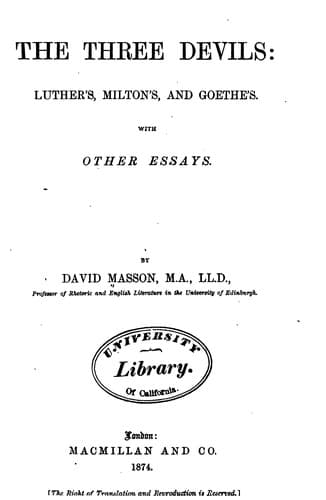
The Three Devils: Luther's, Milton's, and Goethe's; With Other EssaysMasson, David
History
The Three Devils: Luther's, Milton's, and Goethe's; With Other Essays
Masson, David
Devil in literature; Literature -- History and criticism
"As, when the new-born phoenix takes his way
His rich paternal regions to survey,
Of airy choristers a numerous train
Attends his wondrous progress o'er the plain,
So, rising from his father's urn,
So glorious did our Charles return.
The officious muses came along--
A gay harmonious choir, like angels ever young;
The muse that mourns him now his happy triumph sung.
Even they could thrive in his auspicious reign;
And such a plenteous crop they bore
Of purest and well-winnowed grain
As Britain never knew before:
Though little was their hire, and light their gain,
Yet somewhat to their share he threw.
Fed from his hand, they sung and flew,
Like birds of Paradise, that lived on morning dew.
Oh, never let their lays his name forget:
The pension of a prince's praise is great."
If there was any literary man in whose favour James II., on his accession,
might have been expected to relax his parsimonious habits, it was Dryden.
The poet had praised him and made a hero of him for twenty years, and had
during the last four years been working for him incessantly. In
acknowledgment of these services, James could not do otherwise than
continue him in the laureateship; but this was all that he seemed inclined
to do. In the new patent issued for the purpose, not only was there no
renewal of the deceased king's private grant of 100_l._ a-year, but even
the annual butt of sherry, hitherto forming part of the laureate's
allowance, was discontinued, and the salary limited to the precise money
payment of 200_l._ a-year. If, as is probable, the salary was now more
punctually paid than it had been under Charles, the reduction may have
been of less consequence. In March 1685-6, however, James opened his
purse, and, by fresh letters patent, conferred on Dryden a permanent
additional salary of 100_l._ a-year, thus raising the annual income of the
laureateship to 300_l._ The explanation of this unusual piece of
liberality on the part of James has been generally supposed to lie in the
fact that, in the course of the preceding year, Dryden had proved the
thorough and unstinted character of his loyalty by declaring himself a
convert to the king's religion. That Dryden's passing over to the Catholic
church was contemporaneous with the increase of his pension is a fact; but
what may have been the exact relation between the two events is a question
which one ought to be cautious in answering. Lord Macaulay's view of the
case is harsh enough. "Finding," he says, "that, if he continued to call
himself a Protestant, his services would be overlooked, he declared
himself a Papist. The king's parsimony instantly relaxed Dryden was
gratified with a pension of one hundred pounds a-year, and was employed to
defend his new religion both in prose and verse." Sir Walter Scott's view
is more charitable, and, we believe, more just. He regards Dryden's
conversion as having been, in the main, honest to the extent professed by
Public-domain text, read in full here on John Shaqi.
Reviews
Reviews
No reviews yet
Be the first to share your thoughts on this work.
Elsewhere in the archive
Join the Discussion
Join the discussion
Sign in to leave a comment or review.
Sign InorCreate an account