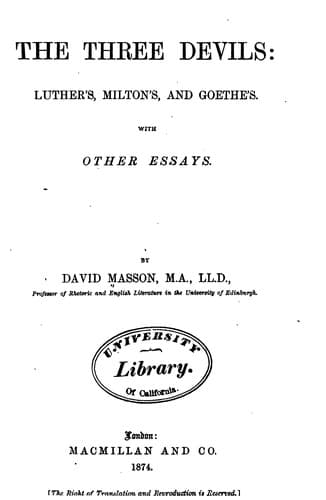
The Three Devils: Luther's, Milton's, and Goethe's; With Other EssaysMasson, David
History
The Three Devils: Luther's, Milton's, and Goethe's; With Other Essays
Masson, David
Devil in literature; Literature -- History and criticism
himself, though his situation and expectations may have co-operated to
effect it. In support of this view Mr. Bell points out the fact that the
pension granted by James was, after all, only a renewal of a pension
granted by Charles, and which, not being secured by letters patent, had
lapsed on that king's decease. Dryden, it is also to be remarked, remained
sufficiently staunch to his new faith during the rest of his life, and
seems even to have felt a kind of comfort in it. Probably, therefore, the
true state of the case is that conformity to the Catholic religion, at the
time when Dryden embraced it, was the least troublesome mode of
systematizing for his own mind a number of diverse speculations, personal
and political, that were then perplexing him, and that, afterwards, in
consequence of the very obloquy which his change of religion drew upon him
from all quarters, he hugged his new creed more closely, so as to coil
round him, for the first time in his life, a few threads of private
theological conviction. This is not very different from the notion
entertained by Sir Walter Scott, who argues that Dryden's conversion was
not, except in outward profession, a change from Protestant to Catholic
belief, but rather, like that of Gibbon, a choice of Catholicism as the
most convenient resting-place for a mind tired of Pyrrhonism, and disposed
to cut short the process of emancipation from it by taking a decisive step
at once.
At all events, Dryden showed sufficient polemical energy in the service of
the religion which he had adopted. He became James's literary factotum,
the defender in prose and in verse of the worst measures of his rule; and
he was ready to do battle with Stillingfleet, Burnet, or anyone else that
dared to use a pen on the other side. As if to make the highest display of
his powers as a versifier at a time when his character as a man was
lowest, he published in 1687 his controversial allegory of _The Hind and
the Panther_, by far the largest and most elaborate of his original poems.
In this poem, in which the various churches and sects of the day figure as
beasts--the Church of Rome as a "milk-white hind," innocent and unchanged;
the Church of England as a "panther," spotted, but still beautiful;
Presbyterianism as a haggard ugly "wolf;" Independency as the "bloody
bear;" the Baptists as the "bristled boar;" the Unitarians as the "false
fox;" the Freethinkers as the "buffoon ape;" and the Quakers as the timid
"hare"--Dryden showed that, whatever his new faith had done for him, it
had not changed his genius for satire. In fact, precisely as during
James's reign Dryden appears personally as a solitary giant, warring on
the wrong side, so this poem remains as the sole literary work of any
excellence in which the wretched spirit of that reign is fully
represented. Dryden himself, as if he had thrown all his force into it,
wrote little else in verse till the year 1688, when, on the occasion of
Public-domain text, read in full here on John Shaqi.
Reviews
Reviews
No reviews yet
Be the first to share your thoughts on this work.
Elsewhere in the archive
Join the Discussion
Join the discussion
Sign in to leave a comment or review.
Sign InorCreate an account