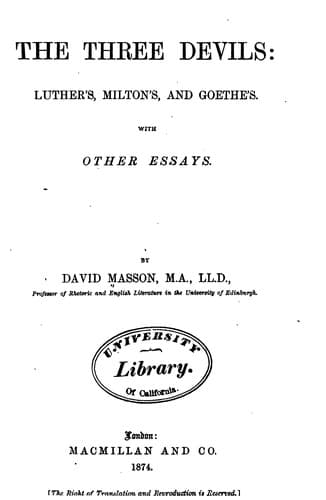
The Three Devils: Luther's, Milton's, and Goethe's; With Other EssaysMasson, David
History
The Three Devils: Luther's, Milton's, and Goethe's; With Other Essays
Masson, David
Devil in literature; Literature -- History and criticism
solid representative of the period as a whole, resuming in himself all
its more prominent characteristics in one substantial aggregate, we are
obliged to take Dryden. Twelve years of his literary life he laboured as a
strong junior among the Davenants, the Butlers, and the Wallers,
qualifying himself to set them aside; eighteen years more were spent in
acknowledged lordship over the Ethereges, Otways, and Wycherleys, who
occupied the middle of the period; and during the twelve concluding years
he was a patriarch among the Southernes, and Priors, and Congreves, in
whose lives the period wove itself into the next.
And yet, personally as well as historically, Dryden is a man of no mean
importance. Not only is he the largest figure in one era of our
literature; he is a very considerable figure also in our literature as a
whole. To begin with the most obvious, but at the same time not the least
noteworthy, of his claims, the _quantity_ of his contributions to our
literature was large. He was a various and voluminous writer. In Scott's
collected edition of his works they fill seventeen octavo volumes. About
seven of these volumes consist of dramas, with accompanying prefaces and
dedications, the number of dramas being in all twenty-eight. Two volumes
more embrace the polemical poems, the satires, and the poems of
contemporary historical allusion, written chiefly between 1681 and 1683.
One volume is filled with odes, songs, and lyrical pieces, written at
various times. The Fables, or Metrical Tales, redacted in his old age from
Chaucer and Boccaccio, occupy a volume and a half. Three volumes and a
half are devoted to the translations from the classic poets, including the
Translation of Virgil. The remaining two volumes consist of miscellaneous
prologues, epilogues, and witty pieces of verse, and of miscellaneous
prose-writings, original and translated, including the critical Essay on
Dramatic Poetry. Considered as a whole, the matter of the seventeen
volumes is a goodly contribution from one man as respects both extent and
variety. Spread over forty-two years, it does not argue that excessive
industry which Scott, of all men in the world, has found in it; but it
fairly entitles Dryden to take his place among those writers who deserve
regard for the quantity of their writings, in addition to whatever regard
they may be entitled to on the score, of quality. And it is a fact worth
noting, and remarked by Scott more than once, that most writers who have
taken a high place in literature have been voluminous--have not only
written well, but also written much. Moreover there are two ways of
writing much. One may write much and variously, or one may write much all
of one kind. Dryden was various as well as voluminous.
Public-domain text, read in full here on John Shaqi.
Reviews
Reviews
No reviews yet
Be the first to share your thoughts on this work.
Elsewhere in the archive
Join the Discussion
Join the discussion
Sign in to leave a comment or review.
Sign InorCreate an account