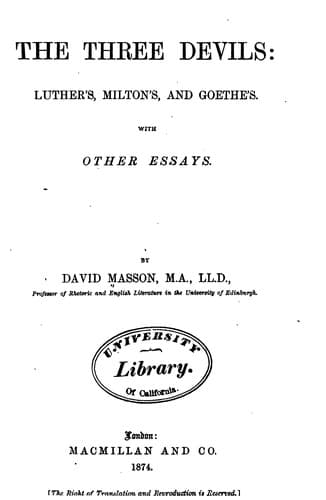
The Three Devils: Luther's, Milton's, and Goethe's; With Other EssaysMasson, David
History
The Three Devils: Luther's, Milton's, and Goethe's; With Other Essays
Masson, David
Devil in literature; Literature -- History and criticism
Of all that Dryden wrote, however, there is but a comparatively small
portion that has won for itself a permanent place in our literature; and
in this he differs from other writers that have been equally voluminous.
It is indeed a significant fact about Dryden that the proportion of that
part of his matter which survives, or deserves to survive, to that part
which was squandered away on the age it was first written for, and there
ended, is unusually small. In Shakespeare there is very little that is
felt to be of such inferior quality as not to be worth reading in due time
and place. In Milton there is, if we consider only his poetry, still less.
All Chaucer, almost, is felt to be worth preservation by those who like
Chaucer; all Wordsworth, almost, by those who like Wordsworth. But, except
for library purposes, there is no admirer of Dryden that would care to
save more than a small select portion of what he wrote. His satires and
polemical poems; one or two of his odes; his Translation of Virgil; his
fables; one of his comedies, and one of his tragedies, by way of specimen
of his dramatic powers; a complete set of his prologues, for the sake of
their allusions to contemporary manners and humours; and a few pieces of
his prose, to show his style of criticism:--these would together form a
collection not much more than a fourth part of the whole, and which would
require to be yet farther winnowed, were the purpose to leave only what is
sterling and in Dryden's best manner. Mr. Bell's edition, which comprise
in three volumes all Dryden's original non-dramatic poetry, and the best
collection of his prologues and epilogues yet made, is itself a surfeit of
matter. It is such an edition of Dryden as ought to be included in a
series of the English poets intended to be complete; but even in it there
is more of dross than of ore.
Public-domain text, read in full here on John Shaqi.
Reviews
Reviews
No reviews yet
Be the first to share your thoughts on this work.
Elsewhere in the archive
Join the Discussion
Join the discussion
Sign in to leave a comment or review.
Sign InorCreate an account