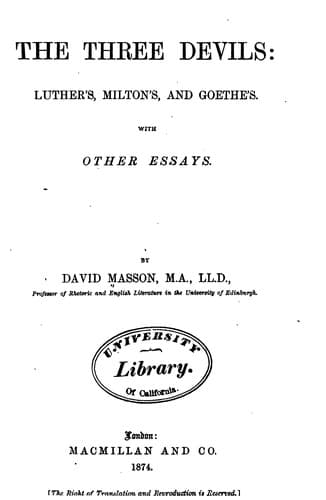
The Three Devils: Luther's, Milton's, and Goethe's; With Other EssaysMasson, David
History
The Three Devils: Luther's, Milton's, and Goethe's; With Other Essays
Masson, David
Devil in literature; Literature -- History and criticism
What is the reason of this? How is it that in Dryden the proportion of
what is now rubbish to what is still precious as a literary possession is
so much greater than in most other writers of great celebrity? There are
two reasons for it. The first is, that originally, and in its own nature,
much of the matter that Dryden put forth was not of a kind for which his
genius was fitted. Whatever his own imagination constructed on the large
scale was mean and conventional. Wherever, as in his translations of
Virgil and his imitations of Chaucer and Boccaccio, he employed his powers
of language and verse in refurbishing matter invented by others, the
poetical substance of his writings is valuable; but the sheer produce of
his own imagination, as in his dramas, is in general such stuff as nature
disowns and no creature can take pleasure in. There is no fine power of
dramatic story, no exquisite invention of character or circumstance, no
truth to nature in ideal landscape: at the utmost, there is conventional
dramatic situation, with an occasional flash of splendid imagery such as
may be struck out in the heat of heroic declamation. Thus--
"I am as free as Nature first made man,
Ere the base laws of servitude began,
When wild in woods the noble savage ran."
Dryden's natural powers, as all his critics have remarked, lay not so much
in the imaginative as in the didactic, the declamatory, and the
ratiocinative. What Johnson claims for him, and what seems to have been
claimed for him in his own lifetime, was the credit of being one of the
best reasoners in verse that ever wrote. Lord Macaulay means very much the
same thing when he calls Dryden a great "critical poet," and the founder
of the "critical school of English poetry." Probably Milton meant
something of the kind when he said that Dryden was a rhymer, but no poet.
It was in declamatory and didactic rhyme, with all that could consist with
it, that Dryden excelled. It was in the metrical utterance of weighty
sentences, in the metrical conduct of an argument, in vehement satirical
invective, and in such passages of lyric passion as depended for their
effect on rolling grandeur of sound, that he was pre-eminently great. Even
his imagination worked more powerfully, and his perceptions of physical
circumstance became keener and truer, under the influence of polemical
rage, the pursuit of terse maxim, or the passion for sonorous declamation.
Thus--
"And every shekel which he can receive
Shall cost a limb of his prerogative."
Or, in his character of Shaftesbury,--
Public-domain text, read in full here on John Shaqi.
Reviews
Reviews
No reviews yet
Be the first to share your thoughts on this work.
Elsewhere in the archive
Join the Discussion
Join the discussion
Sign in to leave a comment or review.
Sign InorCreate an account