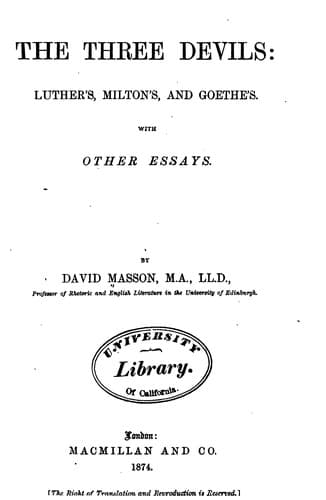
The Three Devils: Luther's, Milton's, and Goethe's; With Other EssaysMasson, David
History
The Three Devils: Luther's, Milton's, and Goethe's; With Other Essays
Masson, David
Devil in literature; Literature -- History and criticism
"Of these the false Achitophel was first:
A name to all succeeding ages curst;
For close designs and crooked counsels fit;
Sagacious, bold, and turbulent of wit;
Restless, unfixed in principles and place;
In power unpleased, impatient of disgrace;
A fiery soul, which, working out its way,
Fretted the pigmy body to decay,
And o'er-informed the tenement of clay.
A daring pilot in extremity,
Pleased with the danger when the waves went high,
He sought the storms; but, for a calm unfit,
Would steer too nigh the sands, to boast his wit.
Great wits are sure to madness near allied,
And thin partitions do their bounds divide."
Or, in the lines which he sent to Tonson the publisher as a specimen of
what he could do in the way of portrait-painting if Tonson did not send
him supplies--
"With leering looks, bull-faced, and freckled fair,
With two left legs, and Judas-coloured hair,
And frowzy pores that taint the ambient air."
And, again, in almost every passage in the noble ode on Alexander's Feast,
_e.g._--
"With ravished ears
The monarch hears;
Assumes the god,
Affects to nod,
And seems to shake the spheres."
In satire, in critical disquisition, in aphoristic verse, or in lyrical
grandiloquence, Dryden was in his natural element; and one reason why, of
all the matter of his voluminous works, so small a portion is of permanent
literary value, is that, in his attempts after literary variety, he could
not or would not restrict himself within these proper limits of his
genius.
But, besides this, Dryden was a slovenly worker within his own field. Even
of what he could do best he did little continuously in a thoroughly
careful manner. In his best poem there are not twenty consecutive lines
without some logical incoherence, some confusion of metaphor, some
inaccuracy of language, or some evident strain of the meaning for the sake
of the metre. His strength lies in passages and weighty interspersed
lines, not in whole poems. Even in Dryden's lifetime this complaint was
made. It was hinted at in _The Rehearsal_; Rochester speaks of Dryden's
"slattern muse;" and Blackmore, who criticised Dryden in his old age,
expresses the common opinion distinctly and deliberately--
"Into the melting-pot when Dryden comes,
What horrid stench will rise, what noisome fumes!
How will he shrink, when all his lewd allay
And wicked mixture shall be purged away!
When once his boasted heaps are melted down,
A chest-full scarce will yield one sterling crown;
But what remains will be so pure, 'twill bear
The examination of the moot severe."
Public-domain text, read in full here on John Shaqi.
Reviews
Reviews
No reviews yet
Be the first to share your thoughts on this work.
Elsewhere in the archive
Join the Discussion
Join the discussion
Sign in to leave a comment or review.
Sign InorCreate an account