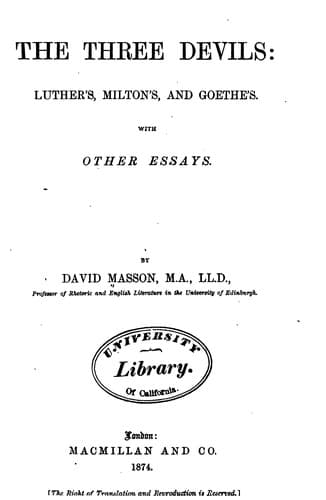
The Three Devils: Luther's, Milton's, and Goethe's; With Other EssaysMasson, David
History
The Three Devils: Luther's, Milton's, and Goethe's; With Other Essays
Masson, David
Devil in literature; Literature -- History and criticism
This is true, though it was Blackmore who said it. Dryden's slovenliness,
however, consisted not so much in a disposition to spare pains as in a
constitutional robustness which rendered artistic perfection all but
impossible to him even when he laboured hardest to attain it. One's notion
of Dryden is that he was originally a _robust_ man, who, when he first
engaged in poetry, could produce nothing better than strong stanzas of
rather wooden sound and mechanism, but who, by perseverance and continual
work, drilled his genius into higher susceptibility and a conscious
aptitude and mastery in certain directions, so that, the older he grew, he
became mellower, more musical, and more imaginative, what had been
robustness at first having by long practice been subdued into flexibility
and nerve. It is stated of Dryden that, in his earlier life at least, he
used, as a preparation for writing, to induce on himself an artificial
state of languor by taking medicine or letting blood. The trait is
characteristic. Dryden's whole literary career was a metaphor of it. Had
he died before 1670, or even before 1681, when his _Annus Mirabilis_ was
still his most ambitious production, he would have been remembered as
little more than a robust versifier; but, living as he did till 1701, he
performed work which has entitled him to rank among English poets. As a
contributor to the actual body of our literature, and as a man who
produced by his influence a lasting effect on its literary methods,
Dryden's place is certainly high.
DEAN SWIFT.
DEAN SWIFT.[7]
In dividing the history of English literature into periods it is customary
to take the interval between the year 1688 and the year 1727 as
constituting one of those periods. This interval includes the reigns of
William III., Anne, and George I. If we do not bind ourselves too
precisely to the year 1727 as closing the period, the division is proper
enough. There _are_ characteristics about the time thus marked out which
distinguish it from previous and from subsequent portions of our literary
history. Dryden, Locke, and some other notabilities of the Restoration,
lived into this period, and may be regarded as partly belonging to it; but
the names more peculiarly representing it are those of Swift, Burnet,
Addison, Steele, Pope, Shaftesbury, Gay, Arbuthnot, Atterbury, Prior,
Parnell, Bolingbroke, Congreve, Vanbrugh, Farquhar, Rowe, Defoe, and
Cibber. The names in this cluster disperse themselves over the three
reigns which the period includes, some of them having already been known
as early as the accession of William, while others survived the first
George and continued to add to their celebrity during the reign of his
successor; but the most brilliant portion of the period was from 1702 to
1714, when Queen Anne was on the throne. Hence the name of "Wits of Queen
Anne's reign," commonly applied to the writers of the whole period.
Public-domain text, read in full here on John Shaqi.
Reviews
Reviews
No reviews yet
Be the first to share your thoughts on this work.
Elsewhere in the archive
Join the Discussion
Join the discussion
Sign in to leave a comment or review.
Sign InorCreate an account