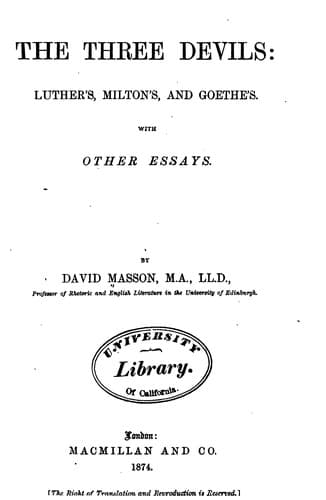
The Three Devils: Luther's, Milton's, and Goethe's; With Other EssaysMasson, David
History
The Three Devils: Luther's, Milton's, and Goethe's; With Other Essays
Masson, David
Devil in literature; Literature -- History and criticism
A while ago this used to be spoken of as the Golden or Augustan age of
English literature. We do not talk in that manner now. We feel that when
we get among the authors of the times of Queen Anne and the first George
we are among very pleasant and very clever men, but by no means among
giants. In coming down to this period from those going before it, we have
an immediate sensation of having left the region of "greatness" behind us.
We still find plenty of good writing, characterized by certain qualities
of trimness, artificial grace, and the like, to a degree not before
attained; here and there also, we discern something like real power and
strength, breaking through the prevailing element; but, on the whole,
there is an absence of what, except by a compromise of language, could be
called "great." It is the same whether we regard largeness of imaginative
faculty, loftiness of moral spirit, or vigour of speculative capacity, as
principally concerned in imparting the character of "greatness" to
literature. What of genius in the ideal survived the seventeenth century
in England contented itself with nice little imaginations of scenes and
circumstances connected with the artificial life of the time; the moral
quality most in repute was kindliness or courtesy; and speculation did not
go beyond that point where thought retains the form either of ordinary
good sense, or of keen momentary wit. No sooner, in fact, do we pass the
time of Milton than we feel that we have done with the sublimities. A kind
of lumbering largeness does remain in the intellectual gait of Dryden and
his contemporaries, as if the age still wore the armour of the old
literary forms, though not at home in it; but in Pope's days even the
affectation of the "great" had ceased. Not slowly to build up a grand poem
of continuous ideal action, not quietly and at leisure to weave forth
tissues of fantastic imagery, not perseveringly and laboriously to
prosecute one track of speculation and bring it to a close, not earnestly
and courageously to throw one's whole soul into a work of moral agitation
and reform, was now what was regarded as natural in literature. On the
contrary, he was a wit, or a literary man, who, living in the midst of the
social bustle, or on the skirts of it, could throw forth in the easiest
manner little essays, squibs, and _jeux d'esprit_, pertinent to the rapid
occasions of the hour, and never tasking the mind too long or too much.
This was the time when that great distinction between Whiggism and
Toryism which for a century-and-a-half has existed in Great Britain as a
kind of permanent social condition, affecting the intellectual activity of
all natives from the moment of their birth, first began to be practically
operative. It has, on the whole, been a wretched thing for the mind of
England to have had this necessity of being either a Whig or a Tory put so
prominently before it. Perhaps, in all times, some similar necessity of
Public-domain text, read in full here on John Shaqi.
Reviews
Reviews
No reviews yet
Be the first to share your thoughts on this work.
Elsewhere in the archive
Join the Discussion
Join the discussion
Sign in to leave a comment or review.
Sign InorCreate an account