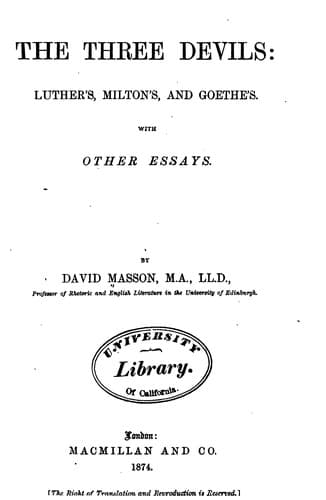
The Three Devils: Luther's, Milton's, and Goethe's; With Other EssaysMasson, David
History
The Three Devils: Luther's, Milton's, and Goethe's; With Other Essays
Masson, David
Devil in literature; Literature -- History and criticism
had lost the rich deanery of Derry, which Lord Berkeley had meant to give
him, in consequence of a notion on the part of the bishop of the diocese
that he was a restless, ingenious young man, who, instead of residing,
would be "eternally flying backwards and forwards to London." The bishop's
perception of his character was just. At or about the very time when the
wits at Button's saw him stalking up and down in the coffee-house, the
priest of Laracor was introducing himself to Somers, Halifax, Sunderland,
and others, and stating the terms on which he would support the Whigs with
his pen. Even then, it seems, he took high ground, and let it be known
that he was no mere hireling. The following, written at a much later
period, is his own explanation of the nature and limits of his Whiggism at
the time when he first offered the Whigs his services:--
"It was then (1701-2) I began to trouble myself with the differences
between the principles of Whig and Tory; having formerly employed
myself in other, and, I think, much better speculations. I talked
often upon this subject with Lord Somers; told him that, having been
long conversant with the Greek and Latin authors, and therefore a
lover of liberty, I found myself much inclined to be what they call a
Whig in politics; and that, besides, I thought it impossible, upon
any other principles, to defend or submit to the Revolution; but, as
to religion, I confessed myself to be a High-Churchman, and that I
could not conceive how anyone who wore the habit of a clergyman could
be otherwise; that I had observed very well with what insolence and
haughtiness some lords of the High-Church party treated not only
their own chaplains, but all other clergymen whatsoever, and thought
this was sufficiently recompensed by their professions of zeal to the
Church: that I had likewise observed how the Whig lords took a direct
contrary measure, treated the persons of particular clergymen with
particular courtesy, but showed much contempt and ill-will for the
order in general: that I knew it was necessary for their party to
make their bottom as wide as they could, by taking all denominations
of Protestants to be members of their body: that I would not enter
into the mutual reproaches made by the violent men on either side;
but that the connivance or encouragement given by the Whigs to those
writers of pamphlets who reflected upon the whole body of the clergy,
without any exception, would unite the Church to one man to oppose
them; and that I doubted his lordship's friends did not consider the
consequences of this."
Public-domain text, read in full here on John Shaqi.
Reviews
Reviews
No reviews yet
Be the first to share your thoughts on this work.
Elsewhere in the archive
Join the Discussion
Join the discussion
Sign in to leave a comment or review.
Sign InorCreate an account