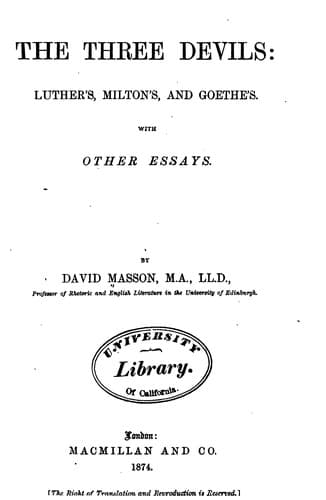
The Three Devils: Luther's, Milton's, and Goethe's; With Other EssaysMasson, David
History
The Three Devils: Luther's, Milton's, and Goethe's; With Other Essays
Masson, David
Devil in literature; Literature -- History and criticism
Even with these limitations the assistance of so energetic a man as the
parson of Laracor was doubtless welcome to the Whigs. His former connexion
with the stately old Revolution Whig, Sir William Temple, may have
prepared the way for him, as it had already been the means of making him
known in some aristocratic families. But there was evidence in his
personal bearing and his writings that he was not a man to be neglected.
And, if there had been any doubt on the subject on his first presentation
of himself to ministers, the publication of his _Battle of the Books_ and
his _Tale of a Tub_ in 1703 and 1704 would have set it overwhelmingly at
rest. The author of these works (and, though they were anonymous, they
were at once referred to Swift) could not but be acknowledged as the first
prose satirist, and one of the most formidable writers, of the age. On his
subsequent visits to Button's, therefore (and they were frequent enough;
for, as the Bishop of Derry had foreseen, he was often an absentee from
his parish), the mad Irish parson was no longer a stranger to the company.
Addison, Steele, Tickell, Philips, and the other Whig wits came to know
him well, and to feel his weight among them in their daily convivial
meetings. "To Dr. Jonathan Swift, the most agreeable companion, the truest
friend, and the greatest genius of the age" was the inscription written by
Addison on a copy of his Travels presented to Swift; and it shows what
opinion Addison and those about him had formed of the author of the _Tale
of a Tub_.
Public-domain text, read in full here on John Shaqi.
Reviews
Reviews
No reviews yet
Be the first to share your thoughts on this work.
Elsewhere in the archive
Join the Discussion
Join the discussion
Sign in to leave a comment or review.
Sign InorCreate an account