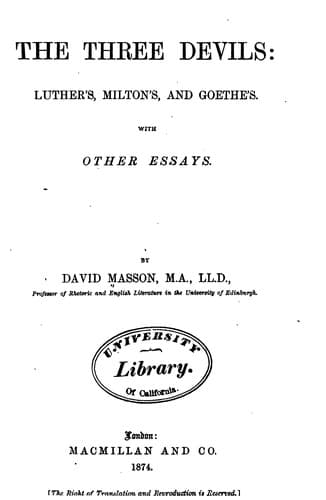
The Three Devils: Luther's, Milton's, and Goethe's; With Other EssaysMasson, David
History
The Three Devils: Luther's, Milton's, and Goethe's; With Other Essays
Masson, David
Devil in literature; Literature -- History and criticism
Altogether, it will be said, Milton was a greater man than Swift; his
intellect was higher, richer, deeper, grander, his views of things were
more profound, grave, stately, and exalted. This is a true enough
statement of the case; and one likes that comprehensive use of the word
intellect which it implies, wrapping up, as it were, all that is in and
about a man in this one word, so as to dispense with the distinctions
between imaginative and non-imaginative, spiritual and unspiritual
natures, and make every possible question about a man a mere question in
the end as to the size or degree of his intellect. But such a mode of
speaking is too violent and recondite for common purposes. According to
the common use of the word intellect, it might be maintained (we do not
say it would) that Swift's intellect, his strength of mental grasp, was
equal to Milton's, and yet that, by reason of the fact that his
intellectual style was different, or that he did not grasp things
precisely in the Miltonic way, a distinction might be drawn unfavourable
to his genius as compared with that of Milton. According to such a view,
we must seek for that in Swift's genius upon which it depends that, while
we accord to it all the admiration we bestow on strength, our sympathies
with height or sublimity are left unmoved. Nor have we far to seek. When
Goethe and Niebuhr generalized in the phrase "the demonic element" that
mystic something which they seemed to detect in men of unusual potency
among their fellows, they used the word "demonic," not in its English
sense, as signifying what appertains specially to the demons or powers of
darkness, but in its Greek sense, as equally implying the unseen agencies
of light and good. The demonic element in a man, therefore, may in one
case be the demonic of the etherial and celestial, in another the
demonic of the Tartarean and infernal. There is a demonic of the
_super_natural--angels, and seraphs, and white-winged airy messengers,
swaying men's phantasies from above; and there is a demonic of the
_infra_-natural--fiends and shapes of horror tugging at men's thoughts
from beneath. The demonic in Swift was of the latter kind. It is false, it
would be an entire mistake as to his genius, to say that he regarded, or
was inspired by, only the worldly and the secular--that men, women, and
their relations in the little world of visible life, were all that his
intellect cared to recognise. He also, like our Miltons and our
Shakespeares, and all our men who have been anything more than prudential
and pleasant writers, had his being anchored in things and imaginations
beyond the visible verge. But, while it was given to them to hold rather
by things and imaginations belonging to the region of the celestial, to
hear angelic music and the rustling of seraphic wings, it was his
unhappier lot to be related rather to the darker and subterranean
mysteries. One might say of Swift that he had far less of belief in a God
than of belief in a Devil.
Public-domain text, read in full here on John Shaqi.
The Three Devils: Luther's, Milton's, and Goethe's; With Other Essays — John Shaqi
Reviews
Reviews
No reviews yet
Be the first to share your thoughts on this work.
Elsewhere in the archive
Join the Discussion
Join the discussion
Sign in to leave a comment or review.
Sign InorCreate an account