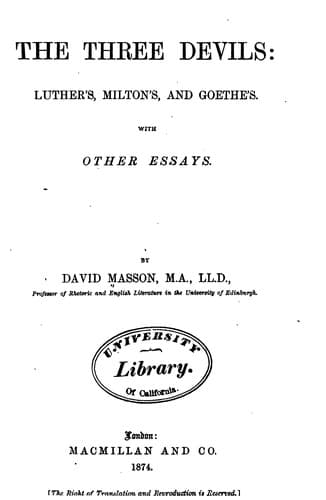
The Three Devils: Luther's, Milton's, and Goethe's; With Other EssaysMasson, David
History
The Three Devils: Luther's, Milton's, and Goethe's; With Other Essays
Masson, David
Devil in literature; Literature -- History and criticism
He is like a man walking on the earth and among
the busy haunts of his fellow-mortals, observing them and their ways, and
taking his part in the bustle, all the while, however, conscious of the
tuggings downward of secret chains reaching into the world of the demons.
Hence his ferocity, his misanthropy, his _sæva indignatio_, all of them
true forms of energy, imparting unusual potency to a life, but forms of
energy bred of communion with what outlies nature on the lower or infernal
side.
Swift, doubtless, had this melancholic tendency in him constitutionally
from the beginning. From the first we see him an unruly, rebellious,
gloomy, revengeful, unforgiving spirit, loyal to no authority, and
gnashing under every restraint. With nothing small or weak in his nature,
too proud to be dishonest, bold and fearless in his opinions, capable of
strong attachments and of hatred as strong, it was to be predicted that,
if the swarthy Irish youth, whom Sir William Temple received into his
house when his college had all but expelled him for contumacy, should ever
be eminent in the world, it would be for fierce and controversial, and not
for beautiful or harmonious, activity. It is clear, however, on a survey
of Swift's career, that the gloom and melancholy which characterized it
were not altogether congenital, but, in part at least, grew out of some
special circumstance, or set of circumstances, having a precise date and
locality among the facts of his life. In other words, there was some
secret in Swift's life, some root of bitterness or remorse, diffusing a
black poison throughout his whole existence. That communion with the
invisible almost exclusively on the infernal side--that consciousness of
chains wound round his own moving frame at the one end, and at the other
held by demons in the depths of their populous pit, while no cords of love
were felt sustaining him from the countervailing heaven--had its origin,
in part at least, in some one recollection or cause of dread. It was some
one demon down in that pit that held the chains; the others but assisted
him. Thackeray's perception seems to us exact when he says of Swift that
"he goes through life, tearing, like a man possessed with a devil;" or
again, changing the form of the figure, that "like Abudah, in the Arabian
story, he is always looking out for the Fury, and knows that the night
will come, and the inevitable hag with it." What was this Fury, this hag
that duly came in the night, making the mornings horrible by the terrors
of recollection, the evenings horrible by those of anticipation, and
leaving but a calm hour at full mid-day? There was a secret in Swift's
life: what was it? His biographers as yet have failed to agree on this
dark topic. Thackeray's hypothesis, that the cause of Swift's despair was
chiefly his consciousness of disbelief in the creed to which he had sworn
his professional faith, does not seem to us sufficient. In Swift's days,
Public-domain text, read in full here on John Shaqi.
Reviews
Reviews
No reviews yet
Be the first to share your thoughts on this work.
Elsewhere in the archive
Join the Discussion
Join the discussion
Sign in to leave a comment or review.
Sign InorCreate an account