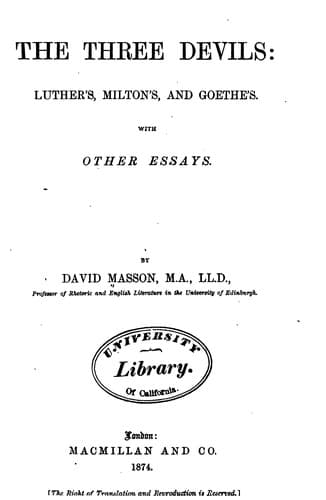
The Three Devils: Luther's, Milton's, and Goethe's; With Other EssaysMasson, David
History
The Three Devils: Luther's, Milton's, and Goethe's; With Other Essays
Masson, David
Devil in literature; Literature -- History and criticism
and even with his frank nature, we think that difficulty could have been
got over. There was nothing, at least, so unique in the case as to justify
the supposition that this was what Archbishop King referred to in that
memorable saying to Dr. Delany, "You have just met the most miserable man
on earth; but on the subject of his wretchedness you must never ask a
question." Had Swift made a confession of scepticism to the Archbishop, we
do not think the prelate would have been taken so very much by surprise.
Nor can we think, with some, that Swift's vertigo (now pronounced to have
been increasing congestion of the brain), and his life-long certainty that
it would end in idiocy or madness, are the true explanation of this
interview and of the mystery which it shrouds. There was cause enough for
melancholy here, but not exactly the cause that meets the case. Another
hypothesis there is of a physical kind, which Scott and others hint at,
and which finds great acceptance with the medical philosophers. Swift, it
is said, was of "a cold temperament," &c., &c. But why a confession on the
part of Swift that he was not a marriageable man, even had he added that
he desired, above all things in the world, to be a person of that sort,
should have so moved the heart of an Archbishop as to make him shed tears,
one cannot conceive. Besides, although this hypothesis might explain much
of the Stella and Vanessa imbroglio, it would not explain all; nor do we
see on what foundation it could rest. Scott's assertion that all through
Swift's writings there is no evidence of his having felt the tender
passion is simply untrue. On the whole, the hypothesis which has been
started of a too near consanguinity between Swift and Stella, either known
from the first to one or both, or discovered too late, would most nearly
suit the conditions of the case. And yet, as far as we have seen, this
hypothesis also rests on air, with no one fact to support it. Could we
suppose that Swift, like another Eugene Aram, went through the world with
a murder on his mind, it might be taken as a solution of the mystery; but,
as we cannot do this, we must be content with supposing that either some
one of the foregoing hypotheses, or some combination of them, is to be
accepted, or that the matter is altogether inscrutable.
Public-domain text, read in full here on John Shaqi.
Reviews
Reviews
No reviews yet
Be the first to share your thoughts on this work.
Elsewhere in the archive
Join the Discussion
Join the discussion
Sign in to leave a comment or review.
Sign InorCreate an account