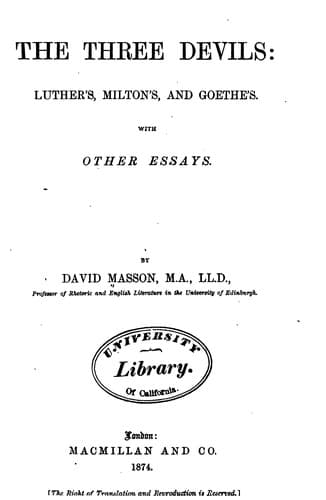
The Three Devils: Luther's, Milton's, and Goethe's; With Other EssaysMasson, David
History
The Three Devils: Luther's, Milton's, and Goethe's; With Other Essays
Masson, David
Devil in literature; Literature -- History and criticism
Such by constitution as we have described him--with an intellect strong as
iron, much acquired knowledge, an ambition all but insatiable, and a
decided desire to be wealthy--Swift, almost as a matter of course, flung
himself impetuously into that Whig and Tory controversy which was the
question paramount in his time. In that he laboured as only a man of his
powers could, bringing to the side of the controversy on which he chanced
to be (and we believe when he was on a side it was honestly because he
found a certain preponderance of right in it) a hard and ruthless vigour
which served it immensely. But from the first, or at all events after the
disappointments of a political career had been experienced by him, his
nature would not work merely in the narrow warfare of Whiggism and
Toryism, but overflowed in general bitterness of reflection on all the
customs and ways of humanity. The following passage in _Gulliver's Voyage
to Brobdingnag_, describing how the politics of Europe appeared to the
King of Brobdingnag, shows us Swift himself in his larger mood of thought.
"This prince took a pleasure in conversing with me, inquiring into
the manners, religion, laws, government, and learning of Europe;
wherein I gave him the best account I was able. His apprehension was
so clear, and his judgment so exact, that he made very wise
reflections and observations upon all I said. But I confess that,
after I had been a little too copious in talking of my own beloved
country, of our trade, and wars by sea and land, of our schisms in
religion and parties in the state, the prejudices of his education
prevailed so far that he could not forbear taking me up in his right
hand, and, stroking me gently with the other, after a hearty fit of
laughing asking me whether _I_ was a Whig or Tory. Then, turning to
his first minister, who waited behind him with a white staff nearly
as tall as the mainmast of the 'Royal Sovereign,' he observed how
contemptible a thing was human grandeur, which could be mimicked by
such diminutive insects as I; 'And yet,' says he, 'I dare engage
these creatures have their titles and distinctions of honour; they
contrive little nests and burrows, that they call houses and cities;
they make a figure in dress and equipage; they love, they fight, they
dispute, they cheat, they betray.' And thus he continued on, while my
colour came and went several times with indignation to hear our noble
country, the mistress of arts and arms, the scourge of France, the
arbitress of Europe, the seat of virtue, piety, honour, truth, the
pride and envy of the world, so contemptuously treated."
Public-domain text, read in full here on John Shaqi.
Reviews
Reviews
No reviews yet
Be the first to share your thoughts on this work.
Elsewhere in the archive
Join the Discussion
Join the discussion
Sign in to leave a comment or review.
Sign InorCreate an account