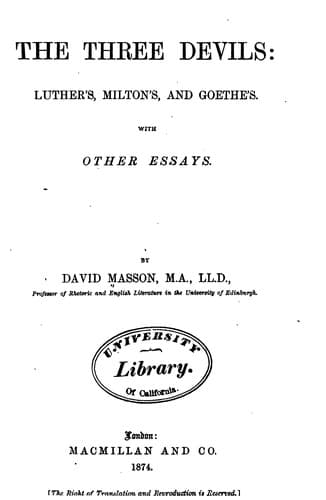
The Three Devils: Luther's, Milton's, and Goethe's; With Other EssaysMasson, David
History
The Three Devils: Luther's, Milton's, and Goethe's; With Other Essays
Masson, David
Devil in literature; Literature -- History and criticism
Swift's writings, accordingly, divide themselves, in the main, into two
classes,--pamphlets, tracts, lampoons, and the like, bearing directly on
persons and topics of the day, and written with the ordinary purpose of a
partisan; and satires of a more general aim, directed, in the spirit of a
cynic philosopher, against humanity on the whole, or against particular
human classes, arrangements, and modes of thinking. In some of his
writings the politician and the general satirist are seen together. The
_Drapier's Letters_ and most of the poetical lampoons exhibit Swift in his
direct character as a party-writer; in the _Tale of a Tub_ we have the
ostensible purpose of a partisan masking a reserve of general scepticism;
in the _Battle of the Books_ we have a satire partly personal to
individuals, partly with a reference to a prevailing tone of opinion; in
the _Voyage to Laputa_ we have a satire on a great class of men; and in
the _Voyages to Lilliput and Brobdingnag_, and still more in the story of
the _Houyhnhnms_ and _Yahoos_, we have human nature itself analysed and
laid bare.
Swift took no care of his writings, never acknowledged some of them, never
collected them, and suffered them to find their way about the world as
chance, demand, and the piracy of publishers, directed. As all know, it is
in his character as a humourist, an inventor of the preposterous as a
medium for the reflective, and above all as a master of irony, that he
takes his place as one of the chiefs of English literature. There can be
no doubt that, as regards the literary form which he affected most, he
took hints from Rabelais as the greatest original in the realm of the
absurd. Sometimes, as in his description of the Strulbrugs in the _Voyage
to Laputa_, he approaches the ghastly power of that writer; but on the
whole there is more of stern English realism in him, and less of sheer
riot and wildness. Sometimes, however, Swift throws off the disguise of
the humourist, and speaks seriously and in his own name. On such occasions
we find ourselves in the presence of a man of strong, sagacious, and
thoroughly English mind, content, as is the habit of most Englishmen, with
vigorous proximate sense, expressed in plain and rather coarse idiom. For
the speculative he shows in these cases neither liking nor aptitude: he
takes obvious reasons and arguments as they come to hand, and uses them in
a robust, downright, Saxon manner. In one respect he stands out
conspicuously even among plain Saxon writers--his total freedom from cant.
Johnson's advice to Boswell, "above all things to clear his mind of cant,"
was perhaps never better illustrated than in the case of Dean Swift.
Indeed, it might be given as a summary definition of Swift's character
that he had cleared his mind of cant without having succeeded in filling
the void with song. It was Swift's intense hatred of cant--cant in
religion, cant in morality, cant in literature--that occasioned many of
Public-domain text, read in full here on John Shaqi.
Reviews
Reviews
No reviews yet
Be the first to share your thoughts on this work.
Elsewhere in the archive
Join the Discussion
Join the discussion
Sign in to leave a comment or review.
Sign InorCreate an account